Friday, January 2, 2026

The Last Days of Christmas...


O God, who wonderfully created, and yet more wonderfully restored, the dignity of human nature: Grant that we may share the divine life of him who humbled himself to share our humanity, your Son Jesus Christ; who lives and reigns with you, in the unity of the Holy Spirit, one God, for ever and ever. Amen.

Other than the song "The Twelve Day of Christmas" (which reliably comes attached with spurious legends about its origin), there is precious little in our day to honor the final stretch of the Christmas season. After January 1 the decorations generally come down, the sales on storage bins and weight loss aids come out, and the consequences of too many weeks of gorging come home to roost. Christmas, though it is not actually over, moves into the rear view mirror until the stores begin hyping it again in about August.

For the more-than-cultural, observant Christian, the last days of Christmastide are firmly focussed on the meaning of Christ's birth for us as believers. What God made possible through the Incarnation of Christ, first revealed in the humble setting of the Bethlehem stable, becomes cosmologically apparent as the season moves towards the feast of the Epiphany and the celebration of the great Theophany at Christ's Baptism. 

This shift of focus and deeper consideration of meaning is perhaps best expressed in our tradition by the above collect (depending on which day of the week Christmas falls, we don't always have a Second Sunday of Christmas--but the teaching in this prayer is nonetheless always present and true).

This prayer succinctly applies Christ's Nativity (He "who humbled himself to share in our humanity") to the the ultimate outcome of that supreme act of love ("...that we may share in that divine life..."). Christ was born into this world that we might be partakers of the divine nature (2 Peter 1:4). He came down so the we may rise; God became human so that humans might become God (St. Athanasius in "On the Incarnation"). It is this radical claim that marks the final stages of the Christmas season.

Eastern Christianity has always put this teaching front-and-center, calling it "theosis," or divinization. Western Christianity, while reluctant to be quite this explicit in terminology, nonetheless does teach something very similar--and Anglicanism explicitly does use this theology in this prayer and in its positive approach to the ultimate goal of our life in Christ, as well as how we regard the sacraments (especially the Holy Eucharist).

For us, the birth of the Savior is not just the beginning of a story that will result in our sins being forgiven on the cross (important as that is), but the beginning of the restoration of the original project of our creation from the start: to share in the divine life. Instead of settling for less (just the settling of scores, in this case) we are being invited into an eternal and mutual indwelling with God in Christ through the Holy Spirit--of which the birth of Christ (Emmanuel, literally "God-with-us") is the essential first step. 

To come to this understanding of the season means going beyond the level of sentiment or seasonal memories and entering into the mystery of God's loving purposes. It also requires connecting Christmas with the entire narrative of Creation-Fall-Patriarchs-Exodus-Temple-Histories-Exile/Return-Prophets-Incarnation-Cross-Resurrection-Ascension-Pentecost-Eschaton. Only when the entire story is told does each "part" take on its appropriate meaning, role, and significance in the seamless garment of salvation. 

Now that the presents are opened and the festivities are winding down we can take the opportunity to gauge whether we are truly seeking what the Lord is offering--or, if we have "settled for less" in our faith, choosing a diminished version of being human rather than the glorious restoration promised to those who dwell more and more in Christ. 

How we approach and experience the coming seasons of Epiphanytide, pre-Lent, Lent, and Easter will depend upon what we believe God offers and what we believe the purposes of humanity actually are. For those who lower their vision of what Christmas is truly about will pack it all away in storage for another repetition in the fall, but those who grasp the glory that is being revealed these twelve days will never truly leave Christmastide's joy. It is ours forever--and ours to share for the remainder of our days in the world God so loved that He gave his only-begotten Son.

A blessed end-of-Christmastide to you.

Friday, August 1, 2025

Vacation Thoughts on Worship

Emptiness in the Church can mean more than the obvious...

When clergy go on vacation and worship elsewhere it is likely they will form some opinions about what they experience. I'm certainly no exception to this. While I try not to abstract myself from the act of worship, it is difficult as a priest and pastor not to look at the apparent assumptions manifest in the public life and liturgy of various churches--their imagery and emphasis as well as their character and "tonality." This allows me to look beyond the admittedly small boundaries of the parish in which I serve, but also to reflect on my own assumptions and practices.

One of the things I often experience while worshipping in a new setting is the question regarding whom we are addressing when we pray. Quite often it seems the prayers, hymns, and actions of worship are really being directed toward each other rather than God. Sometimes it is the slipshod way prayers are read, or the posture used (almost invariably directed toward the people in Western Christian churches, aside from a few High Church hold-outs), or blasé attitude taken by the congregation. Taken together there is the strong sense that when we gather the focus is on us, not the transcendent God. The teaching about liturgy being the work of worship of God by the people has sunk to a focus largely on the people.

Decades of emphasis on immanence, accessibility, and so-called relevance (a non-negotiable concept, yet one never really explained in theological or scriptural terms) has left many clergy and lay leaders bereft of understanding, talent, or skill in leading the people's praises. This, in turn, makes not for worship but entertainment--and all that means in an attention economy. 

In my own tradition this results in clergy who cannot use the materials of the liturgy with any degree of facility (thus drawing the attention to themselves) and lay leadership, utterly unfamiliar with the skills associated with their role through lack of training, spitballing their way through worship and inventing various folksy customs devoid of theological coherence or spiritual depth. It is often a few older people and some of the longtime church musicians alone who provide any respite from the relentlessness of this empty relevance, and I thank the Lord for them.

The upshot is that many churches today, long conformed to secular notions of success and relevance, "produce" worship which is not terribly transformative nor awfully substantial. This results in a case of "hiding one's light underneath a bushel basket" by veiling the liturgy in consumerist terms. With most churches simply not up to offering even very effective entertainment, the outcome is a bland clubbiness acceptable to some weary Boomers and Gen-X'ers vaguely remembering past church associations but utterly irrelevant (to turn the word around) for many younger people who are looking not only for a soothing or easy welcome leading nowhere in particular, but for an encounter with God, New Life in Christ, and a substantial banquet of teaching, practice, and community to provide meaning and substance absent in their secular life.

As long as I have been ordained (which is getting to be a good long while now) I have seen this mindset grip the American Christian scene. Many church traditions (including my own, sadly) seem still to be in the thrall of this misunderstanding. While there are some fine exceptions, it takes a great deal of energy, skill, and focus to resist the officially-sanctioned trend toward self-worship and immanence-overload. 

Some church traditions are far more resistant to this mutilation of worship, of course, but most are not. And, as long as there are a large number of people committed to the project of relevance-at-all-costs, there can be little opportunity for real consideration and change. For such people, no amount of decline in their church tradition (or growth and effectiveness in other traditions) will ever shake their commitment to this outdated and banal strategy. The grave alone will wrest what is left of their church communities from their doctrinaire, implacable hands.

I don't expect this post to change anything, nor do I consider it a thunderbolt of insight, but I place it here to mark a spot on the Internet where the standards of the day are not winked at, ignored, or shrugged off. Our calling is, in the words of 1 Peter 2:9, to be "a chosen people, a royal priesthood, a holy nation, God’s own people," in order that we may proclaim the excellence of him who called us out of darkness into his marvelous light. The worship we offer and the communities we foster should reflect this rather than turn our back on it.

Thursday, August 29, 2024

The Bible in the Weeds


On one of my recent litter-collection jaunts at church I came upon a surprising sight. A bag (likely stolen) had been eviscerated in a corner of the property, its picked-over contents strewn about, one of which was a battered and dew-spattered copy of the New Testament. Its gold lettering sparkled in the morning light and looked as surprised to be there as was I to find it.

At first I thought of how odd it was to find the majestic King James Version of the New Testament flung promiscuously on the earth and how it conflicted with the absolute rule I was taught as a child that the sacred scriptures must never be allowed to touch the ground. Then I reflected on how we never know where we will find the sacred in our daily life--in the form of people, nature, or even in what appears at first to be garbage.

I took the Bible into my office to dry it out. For some reason it seemed oddly important to me and I kept thinking about it, but couldn't figure out why. Then it came to me; it was the feeling of recognition. I, too, have been cast by circumstance into odd and confusing situations and had to rely on the care of others to be picked up from my desperate condition. If I hadn't been out to clean up trash that morning the book would be have been drenched in the rain and ruined. It all felt like a parable of rescue.

For a time, I was wondering what to do with this book. Now I know: I'm going to read from it as a form of intercession for all those people--myself included--who feel lost and need someone to go looking for them, even accidentally.

The Bible in the weeds describes all of us at one time or another: sacred but dumped, disregarded but message-bearing, lost but still precious.

Keep on walking in the world, looking for who and what needs finding--even if in an unexpected form. It could be the self you thought stolen, the neighbor you never met, or the key to opening your heart all over again.

Brandon+


Tuesday, August 6, 2024

Going with Jesus to Glory: The Feast of the Transfiguration


When Jesus said that some of those who heard him speak would see him come in glory before they died, he was not using hyperbole. Only a few days later, he took those disciples best-suited to this experience with him on a day-hike up a nearby ridge. At its summit they saw him elevated in the air, glow with an unearthly light, and be joined by two of the greatest figures in Jewish history: Moses and Elijah. A cloud then enveloped them all, and a voice from it spoke: “This is my Son, my Chosen: listen to him!”


The Feast of the Transfiguration records an event found in the Gospel accounts of Matthew, Mark, and Luke. This event looks forward through the crushing experience of the Crucifixion and mysterious event of the Resurrection toward an event which has yet to come: Christ’s return in glory. It is an event which frames all of the Gospel story within the context of glory—God’s glory, and ours.


Authentic Christianity refuses to conform the human person to our current state. The often broken, divided, and abused condition of humanity that we see all around us is not our destiny. It is our current state, but it is temporary. The Gospel shows us who we really are: made in the image and likeness of God and the worthy object of God’s loving, healing work. The distorted, pessimistic picture of humanity some forms of Christianity peddle is nothing more than a concession to this condition and will always result in more of the same.


The Gospel vision for humanity is not found in shame and self-loathing. Proceeding from humility and repentance, it ascends the holy mountain of spiritual knowledge and growth toward true awareness of God, neighbor, creation, and self. That knowledge is expressed by the word “glory.” The glorious beauty of God, the radiant splendor the creation, and the shining, glorious reflected light of God found in the human person restored to wholeness in Christ Jesus.


To follow the command given by the divine voice to “listen to Christ” means far more than just following a set of rules or prescribed actions. It is the path back to our true selves as found in right relationship with God, neighbor, and self. It means turning our gaze from the damage in our life toward the image of divine glory seen in Christ on the Holy Mountain.  Once we do this, we begin to perceive our own destiny—and that of every other person embraced by this light.


Today’s feast looks back to an event in history which points us toward another event already accomplished in Jesus Christ and now available to us through Him. Once we take that Transfigured moment seriously, we may share in it ourselves through worship, prayer, service, deeds of love and compassion, contemplation, work and recreation, and the myriad other ways it may be experienced.


In so doing, we will find that the Holy Mountain is not only in a far-off land, but within each of us and available at any hour.  All we must do is turn from ourselves, behold Jesus, and listen to Him.  Then, the cloud descends anew and we are partakers of His glory once more.

Wednesday, July 3, 2024

The Unexpected Voice: Balaam’s Donkey and the Church


Like all others in the Episcopal Church who use the Lectionary to read and pray the Scriptures daily, I had the pleasure of hearing the story of Balaam’s donkey this week (Numbers 22:21-38).  This passage often raises smiles when read in groups—or, even alone—for its combination of naïve (in its original sense) storytelling, vivid characterization, and surprising content.  It is, however, worthy of some consideration and reflection for the serious message it bears amidst the irony and comedy.

Balaam is riding his donkey while going to meet Balak for what would turn out to be an unsatisfactory stint of employment to curse the Hebrews.  Along the way the donkey sees the angel of the Lord, with drawn sword, in the road.  Sensibly, the donkey detours into a nearby field.  Balaam whacks the donkey; smarting, the poor beast obeys and continues on.


A little later, the angelic figure returns, this time in a lane with walls on either side.  Obediently the donkey squeezes between the angel and the wall—no mean feat—and continues on.  This is a courageous as well as skillful and obedient donkey.  However, during this delicate maneuver the donkey had to rub up against the wall, crushing Balaam’s foot.  More whacking ensues.


Finally (ah, yes, three times!) the angel appears to the unnamed donkey in such a way that there was no way around.  Perhaps surrendering to its fate, the critter simply folds its legs and rests on the ground.  Then all hell breaks loose.


Angry and, one presumes, mystified, Balaam uses his staff to beat the donkey. The picture is both very sad and very ironic.  The Seer who cannot see beats the “dumb animal” that can.  This image, which makes one think of St. Paul’s teaching that all Creation groans under the consequences of human sin, is a pitiable miniature of all the folly and spiritual blindness humans commit and suffer from throughout the ages, and the toll it exacts on everything.


Then perhaps comes the real point of the story: the donkey speaks.  “What have I done to you, that you have struck me these three times?"  Balaam doesn’t blink, even for second, at this.  The text has him shoot back his self-justification: “Because you have made a fool of me! I wish I had a sword in my hand! I would kill you right now!"


Here is revealed the condition of everyone who abandons simple humanity to live in the ego.  All behavior is justified, no matter how vile, because “you have made a fool of me!”  Our appearance, our standing, our control, our comfort, our need to be respected by others—is a bottomless pit of rage, ready to open up whenever we are thwarted.  People, animals, objects, the Creation around us, even God are all swept into the drama of our ego-centered universe, culminating in Balaam’s threat to annihilate the donkey.  A surreal picture of a man witnessing a miracle who threatens to extinguish the very miracle itself is thus made complete.


To this nihilistic outburst (which is as comic as tragic), the donkey calmly addresses himself.  He patiently pulls Balaam from the edge of insanity with these logical words: “Am I not your donkey, which you have ridden all your life to this day? Have I been in the habit of treating you this way?"  


Balaam considers this request—never commenting on the novelty of the conversation once—and replies simply: “No.”  That is all he says.  Stopped in the midst of his violent fulminations by the solid and honest reasonings of his donkey, servant, and (really) friend, Balaam ends up climbing off the ledge and resumes being human.  Only at that moment are Balaam’s eyes opened by God to see the angel in the road, with drawn sword in his hand, blocking the way.


The angel is not amused by Balaam’s violence.  Rather than being merely a quaint detail of a folk tale, the striking of the innocent and faithful donkey is brought up as an accusation against Balaam.  God sees all we do—in the heat of the moment or in recollected calm.  We are responsible.


The angel then speaks at some length in praise of the donkey, saying that if it had not reacted so wisely, the angel would have killed Balaam and spared the donkey.  The issue at hand is not the donkey’s disobedience or obstreperousness, but Balaam’s perversity—his intention to thwart the way of the Hebrews as they journey to the Promised Land.  By standing in the way of Balaam, the angel is expressing what Balaam is trying to do to God.  Only then, after listening to a talking donkey and a sword-bearing angel, does Balaam finally become fully human: he repents in word and deed and agrees to do what God commands.


Balaam’s repentance eventually leads to the comical scene which follows: blessings coming out of this paid curser’s mouth.  Balak’s desire for control over God and the Hebrew people is upended by the very “donkey” he has hired to do his bidding.  The irony is complete.


We in the Church, however, would do well to think over this seemingly odd story with great care.  When the faithful souls who do the hard work in the Church’s life, often for years and without comment or criticism, suddenly balk, what do the leaders do?  Do we dismiss them?  Figuratively strike them by demanding compliance with our goals?  Do we end up saying something very similar to the Pharisees in John 9:34: “‘You were born entirely in sins, and are you trying to teach us?" Or, in John 7:49, when the educated leadership speaks of the crowds turning to Jesus: “…this crowd, which does not know the law—they are accursed.”


And beyond balking, what if these same people should dare speak? The unaccustomed voice in the Church, in our communities, in our neighborhood, family, or online—what do we do when this voice speaks?  Balaam’s donkey could see what the Seer could not.  The quiet person, who does the work but does not “theologize” in the Church or “take the floor” in the workplace or family or online likely sees the reality of what is happening from a vantage point completely beyond the people "at the helm."  When such a person balks at plans, or turns away from the announced agenda, what do we do?  Do we enquire, consider, listen?  Or, do we metaphorically strike out at the suddenly out-of-turn or unpliable messenger?


In the current era of the Culture War heresy it has been fashionable to say that this sin is most often committed by the “side” one opposes, but my experience suggests that it is really an equal-opportunity error.  Whenever our wills become perverted from the basic will of God we end up “walloping the donkey,” so-to-speak.  When we are lost in our ideology, our supposed powers or knowledge or authority, we re-enact this story in our own way.  The Church is, sadly, especially vulnerable to this due to our willingness to turn opinion into truth.  This is particularly evident when we hear little of Jesus and much of ideology, "tradition," or the need for "relevance" in the conversation.


The story of Balaam’s donkey has many meanings, of course; but for me during this year’s reading, it is a reminder to consider what I am becoming as I go through life—based on how I perceive and treat everyone and everything along the way.  It is also an invitation to grasp the freedom found in repentance.


When I was growing up, my mother would sometimes say to me: “Just who do you think you are?”  It is a worthwhile question, as also is “Just who do you think others are?” whenever we are thwarted in our plans and expectations.  An angel just might be standing before us.


Most of all: don’t beat the donkey.  Listen to it.  You may have been riding a true Seer and Prophet all along.

Monday, May 20, 2024

After Pentecost: “Ordinary” Time & Eternity


On the day after Pentecost (Whitsunday), the church's calendar makes a sudden shift.  Eastertide is over, Ordinary Time has begun.  Rather than the progression of events from Christ's rising through his various post-resurrection appearances, then the Ascension and the gift of the Holy Spirit on the Fiftieth Day, time in the church calendar becomes a succession of Sundays numbered or ordered after Pentecost—thus “ordinary” time.


Contingent on Easter’s lunar-determined position, this part of the Ecclesiastical Year has to be extra flexible.  Rather than starting on a fixed date, it “floats” back and forth each year.  To accommodate this, Ordinary Time begins on a given “Proper,” a week of readings and a collect for both the Eucharist and the Daily Office that are proper to that week.  The Sunday of each “Proper” is described as being closest to a particular date.  Thus, in years when Easter falls late, the week after Pentecost will use readings and the collect from Proper 4 or 5, but on years when Easter falls early, it might be from Proper 2 (or, if Easter is exceptionally early, Proper 1). 


In this way, Ordinary Time is a bit like an accordion—stretching back and forth with Easter’s date and ending in November so that there are always four Advent Sundays prior to Christmas Day.  The other period of Ordinary Time—the weeks after the Epiphany—does this in reverse, with the day of the week on which Christmas (and thus the Epiphany) falls setting its start, and Ash Wednesday (contingent on Easter’s date) forming the conclusion.


Once learned, this approach to time has spiritual benefit beyond its practical application: it reminds us that what we experience as the inevitable progression of time in this world is ultimately framed by eternity.  For, just as the ordinary times of the Church Year begin and end with great feasts celebrating eternal truths, so our lives on earth are set in the midst of an eternal “before” and a heavenly “ever-after.”


 In the great Seasons of the Church Year (Advent-Christmastide-Lent-Easter) we focus on the teachings of the catholic faith as found in the Creeds and especially on the centrality of the Incarnation and the Paschal Mystery to the Christian community and believer.


In Ordinary Time we put the focus on the orderly telling of scriptural stories in the Daily Office and a deep examination of Jesus’ public ministry and teaching in the Sunday Gospel lessons.  These stories give meaning and application to the eternal truths proclaimed in the creeds.  They are the filling of the sandwich, so-to-speak. Being made in the image of God yet also born of earth, we need both the teaching and the application, the eternal and the earthly.


In all things, the Church Calendar is a tool by which we enter into the mystery of time and eternity.  It gives meaning to our journey through life and also connects our daily, weekly, and annual rhythms with what transcends them.  The Church Year shows that there really is no “ordinary” time in the sense we usually understand that term—only time lived in the presence of the Eternal God, consciously or unconsciously, purposefully or aimlessly, lovingly or pointlessly.  The choice is ours.

Monday, November 27, 2023

Between Thanksgiving and Advent...


This can be a confusing period of time--as this book cover suggests.

As we end November and approach December the civil and church calendars coexist in a somewhat unusual manner in the U.S.  Often, Thanksgiving Day is the immediate herald of Advent, but November has five Thursdays this year (Thanksgiving currently is the fourth Thursday of November, not the last Thursday of the month), and this gives a longer-than-usual gap between the culmination of the fall and the start of the Church’s preparation for Christmas—time available for consideration and use in the spiritual life.

Under the current (1979 BCP) version of the Church Year, the last weeks of the annual cycle focus on themes of judgement, harvest, completion, and the consequences of time meeting eternity.  These traditional Advent themes are, in effect, stretched out into something like a preamble to that season, emphasizing the elements of our faith summed up in the creeds around the “Judgment of the quick and the dead.”  This includes a healthy dose of eschatology and its intensity--the "secret sauce" of all authentic Christianity.


This emphasis allows Advent itself to be focused largely on joy—both the joy of Christ’s first coming (Incarnation/Nativity) and the joy of his second coming at the end of the ages.  This is different from prior calendars which tended to look at Advent in more explicitly penitential ways.


Because so much of Western Christianity’s understanding of eschatology has been built on fear, terror, remorse, shame, and condemnation, the other side of the coin is rarely considered.  The form Advent now takes in our calendar is less about The Four Last Things of death, judgment, heaven, and hell, and more about living in such a way that we will hear with joy the words “Behold, the Bridegroom comes!” at the end of time.


The biblical figures we focus on in the coming season are: the prophet Isaiah, the Prophet of the Advent; Christ’s Forerunner, St. John the Baptist; and the God-bearer, St. Mary the Virgin.


Isaiah prepares us for God’s shocking action of bringing the Messiah to us; the Baptist heralds the Messiah’s arrival, and the Blessed Virgin consents to God’s election and bears the Christ-child so that God may share in our life and redeem it “from within,” so-to-speak.


Through all of these weeks, the two aspects of our redemption—the proving, testing fire of judgment and the comforting, healing embrace of love—are explored and shown to be but two sides of the same coin.  To dwell in the Kingdom of God means an entrance into the divine presence and our true selves, an entrance in which all sin is ultimately consumed and all distortion stripped away in the ravishing, glorious totality of God’s love.  This is at the heart of authentic eschatology and forms a major part of the preacher’s and teacher’s work in this part of the Church Year.


Most years, all of this happens in quick succession—The last Sunday after Pentecost, with its imagery of judgement and enthronement being followed by the harvest thankfulness of Thanksgiving Day and then almost immediately by Advent Sunday’s proclamation of “Sleeper’s, Awake!”


This rapidity is as it should be, really.  The scriptures testify that God’s judgement will be sudden, not a bureaucratic “process” involving lots of forms and delays, nor a test we “study up” for.  Yet, the insertion of an extra week from time-to-time (as with this year) does afford us the opportunity to consider a couple of thoughts: God’s mercy in allowing time to repent, and the difference between judgement and simple retribution.


This extra space of time between Thanksgiving/The Last Sunday after Pentecost and Advent Sunday is a reminder that God often grants us time to draw back and change direction.  This space for repentance is one of the many ways God shows mercy, and something to give thanks for, always.


The other point I would like to make about this week is that it shows how God’s judgement is a considered matter, a revealing of our journey, intentions, and purposes, rather than mere retribution or spite.  


The parables of judgement in the Gospel are not about a capricious deity just showing off power for power’s sake, but the working out of consequences of deeds done (or not done).  


We can go for long periods without thought to the kind of life we are building, but all the while, we are still building it.  That is our “life project,” and it is the offering we will make at the end of our earthly pilgrimage.  The space between these parables of judgement and Advent Sunday is a good time to think seriously about the nature of that offering, and how we may use this Advent season to renew and re-form that offering so it may be worthy of the eternity on the edge of which we stand this season—and every day—as members of Christ’s body.


Enjoy this week, and use it wisely!

Saturday, October 28, 2023

"That All Who Seek You Here May Find You..."


Almighty God, to whose glory we celebrate the dedication of this house of prayer: We give you thanks for the fellowship of those who have worshiped in this place, and we pray that all who seek you here may find you, and be filled with your joy and peace; through Jesus Christ our Lord, who lives and reigns with you, in the unity of the Holy Spirit, one God, now and for ever.  Amen.


This Sunday St. Timothy’s will observe one of its two Parochial Feasts: the dedication of its church (the other is its “feast of title,” the commemoration of St. Timothy in January). This annual event recalls the dedication liturgies in this parish’s history: of the first church building (now our parish hall), of the second (and current) nave, and of the educational, office, and chapel addition in 1997.


This liturgy has several special characteristics. First of all, it is a feast with its own collect, lessons, prayers of the people, and hymns. It opens with a Festal Procession, with a collect at  a station where the icon of our  patron St. Timothy is displayed. The Gloria in excelsis, the great hymn of praise from the early Christian era reserved for major feasts, is sung as the altar is censed. Deceased benefactors and members of St. Timothy’s are recalled in our prayers. Finally, before the liturgy concludes, a solemn Te Deum is sung, giving God especial thanks for this house of prayer as a guaranteed place of meeting and as a center of mission. So much for the liturgical details.


What must be of greater concern for us is the meaning behind this feast and its special elements, for the liturgy is a direct participation in the mystery of God the Holy Trinity, and a showing forth of the Kingdom of God, dawning even now in its fullness by the action of the Holy Spirit. What, then, does this liturgy signify to us?


The collect for the feast puts two things front-and-center: communion and its fruits. The Feast of Dedication is a thanksgiving for communion in its many forms: fellowship with God, fellowship with other disciples, fellowship with those who have already entered eternal life. It is also a plea to God that this parish—holy ground, dedicated to God’s way, God’s presence, a kind of divine beachhead in our agonized and strife-torn world—may always be a place where people may find God and be filled with divine joy and peace.


Ours has become a “desacralized” world; that is a fancy word for the condition of having little or no holiness. In its place, we have tried to substitute the material, the commercial, the purely physical, or the ideological. All around us we see the grotesque results of this experiment: addictions, obsessions, environmental degradation, the commodification of human life, industrialized killing, and the reduction of mystery and awe to such slogans as “follow your bliss”, “it’s all good”, or the demand for conformity to a particular political party or opinion. The hunger for something more is being bought off—temporarily—by a less and less effective array of consumerist and ideological stop-gaps. 


But the Church has the one thing that will satisfy that hunger: communion with God, with the creation, and with each other. Here, in this place, the cheap and sleazy answers the world hands out are not offered. Here, the utter connectedness of all things to their God is revealed. Here joy and peace are not just words: they are the currency of our shared life. Each Eucharist is a joyful renewal of that fact, reaching out beyond the buildings of St. Timothy’s into the lives of its members throughout this city and its surroundings.


The Feast of Dedication is no self-congratulatory party wherein this parish looks admiringly at itself in a mirror. It is a thanksgiving for the grace of God leading to the foresight, sweat, and sacrifice of those who came before us to bring about this parish’s physical presence. But it is more than that: it is a rousing call to take seriously the preciousness of Holy Ground in a city where hope, justice, peace, relationships, and even human life have become just words. 


Here, at this place, the Kingdom of God is made known at each Eucharist, in each class or parish event. Here, those who seek God are able to find him: imperfectly, yes—but find God we may. For the Lord has blessed it, set it apart, making it a portal through which all may enter and be restored, refashioned into what we were created to be from the foundation of the world: the Royal Priesthood of Creation.


Let us give thanks for the dedication of this parish and live out its promise. Like all churches who retain zeal for the Kingdom of God, it is a beacon of hope in a world awash in turmoil, anxiety, and fear.

Monday, July 31, 2023

Lammastide: Earth, Altar, and Us All


The first day of August is traditionally called Lammas Day – a term coming from an earlier form of English that means “Loaf Mass” Day. This was the day when wheat flour from the recently-begun harvest was made into loaves (often of an intricate form), baked, and then brought to the Eucharist to be blessed. It was a sign of gratitude to God for the new wheat crop and an opportunity for communal celebration of God’s provision and all the coordinated labor that went into it. 

Until recently the direct connection between the earth, sustenance, human labor, community, and God was self-evident. If the crop failed, people went hungry, disease spread, and the possibility for all sorts of chaos became much greater. Village life – where most people spent their relatively short existence – left no room for global markets and Grubhub deliveries. It was a remarkably clear-eyed and relational world then: what was grown nearby through ceaseless toil and much uncertainty provided for survival. The various agricultural holy days in the English Church calendar (Plough (or Plow) Sunday, Rogationtide, Lammastide, and Harvest Home) brought human need to God’s throne through supplication, intercession, benediction, praise, and gratitude. The earth and the altar were directly connected through the plow, the worker’s hands, the barn, and the cottage hearth. 

In our current day, these direct relationships have been obscured. The abundance of food in our society would startle people from less than a century ago. The seemingly-ceaseless flows of deliveries to stores and homes have disconnected the various parts of the chain in many people’s mind. No longer are worship, community, labor, and the individual fully integrated: they exist in a disbursed universe of specialties. Worship is quite often more of a performance or a weekly ideological fill-up. Community now generally means mere likemindedness, online more often than in person. Labor has become hidden from view and treated as a kind of necessary evil rather than a sacred act. What prevails today is just the individual, the all-important consumer.  

Yet, when the pandemic upset all the supply-chains and production patterns, we had a momentary taste of the chaos and fear our forebearers knew well. Many people entered into full-on panic. Divisive attitudes, fantastic delusions, and apocalyptic hysteria proliferated. A few, however, knew that an essential part of the response to the situation had to be worship. Those of us formed by traditional Anglican/Episcopal patterns of worship knew about the centrality of those old practices of supplication, intercession, and thanksgiving. By engaging in them we drew closer to God and to each other rather than engaging only in panic. Earth, community, altar, and believer were pulled together once again.

The observance of Lammastide, or some version of it, would be good to re-institute in our churches (provision for it remains in the Church of England). It would be one more way for us to live out our message of hope, community, and communion. It would also be a very visible way to connect the earth, the altar, and us again. Rather than retreat further into the disconnected and anxious culture of darkness around us, we would be far wiser to gather together in the light of Christ, ask God’s blessing, and give thanks for the Creation and its many gifts – including each other. 

But this will take courage, faithfulness, and vision. 

St. Timothy's -- which has long observed the Rogation Days -- will observe Lammastide this Sunday as part of our renewed focus on the connection between Creation and Liturgy.  What will your community do to begin or continue this work?

Wednesday, March 15, 2023

Mid-Lent Sunday

The Church at Little Gidding
 

Midwinter spring is its own season
 Sempiternal though sodden towards sundown,
 Suspended in time, between pole and tropic.
 - from ‘Little Gidding’ (No. 4 of “Four Quartets”) by T.S. Eliot

This Sunday forms the transition in the Lenten Season from the focus on our own need for repentance to Christ’s work of bringing about our reconciliation with God. Thus, it turns our attention from our sin (which can become a sort of obsession if we are not careful) towards God’s love. Like Eliot’s ‘Midwinter spring,” we have come to a moment that is between two seemingly opposite things: Ash Wednesday and Easter Day… yet this moment is but part of a reality of which both Holy Days partake. 

 Mid-Lent Sunday (also known by an entire raft of other names: Laetare, Mothering Sunday, Refreshment Sunday, The Sunday of the Five Loaves, &c.) is a brief respite from our usual Lenten observance; it is also an open invitation to take the season seriously if we have previously not. As St. John Chrysostom will remind us at the Easter Vigil (in his famous sermon), it is not too late to begin our preparation! 

 On a deeper level, though, this Sunday moves us from a focus on our sinfulness to the freedom and forgiveness we receive in Christ. The Gospel reading for this Sunday makes the choice very clear: either we are like the man born blind, who received the gift of sight from God as a gift, or we are like the Pharisees whose love for God had become twisted into a bitterness that could ignore the miracle in their midst and instead condemn both the recipient and the giver. 

 Mere religion will side with the Pharisees. They were simply “following the rules.” True Christian discipleship will choose the riskier path of Jesus, though…because it brings freedom and the capacity to love. As has been said, humanity is always suspended between the law of this world and the love of God, and it must choose.

Let the rest of Holy Lent be a conscious examination of our preferences, so that when we arrive at Holy Week, we will choose love, knowing there is no other way to the peace we seek, the potential self our God has in store for us.


Wednesday, March 1, 2023

Lent: The Season of Spiritual Heart Surgery


The Collect for Ash Wednesday, which may be used throughout the season, asks God to give us “new and contrite hearts.” 

The renewal of our true and innermost being—symbolized by the heart in biblical language—can only happen by a kind of surgical re-shaping (contrition means “to wear down” or to “grind away”). This is one of the main purposes of Lent, and each year we are called to take seriously where God is calling us to open our lives to his providential, careful work of healing and softening hardened, sick hearts.

The passage below is from one of the earliest extant Christian documents, perhaps even older than some of the books of the New Testament in their final form. It is from a letter written by the Bishop of Rome to the Christians of Corinth when their internal dissention had risen like a thundercloud on the horizon of the Church’s mission. Their divisions were hurting the common life of the Body, and Clement sought to do the work of a true pastor: open the eyes of the flock to the truth of their situation, giving them the remedy. Like all Christians, they stood in need of repentance when they had lost their way.

The season of Lent is, to a certain degree, a renewal of our sense of eagerness for the Kingdom of God, something early Christians knew and felt with great naturalness. Such eagerness exposes everything adverse to God’s way of love, exposing it to view and inviting the Master Surgeon to remove the cancer of sin, wherever it grows. It is that heartfelt desire Lent seeks to rekindle in us, for this season and beyond.

If we want as individuals and as a community to experience something of the transforming grace and motivating energy of ancient and authentic Christianity, we must offer ourselves for the same surgical procedure without delay. For, as Scripture says, “now is the acceptable time,” and a new and healed heart awaits us…our very lives depend on it!
+   +   +

            Let us fix our attention on the blood of Christ and recognize how precious it is to God his Father, since it was shed for our salvation and brought the grace of repentance to all the world.
            If we review the various ages of history, we will see that in every generation the Lord has offered the opportunity of repentance to any who were willing to turn to him. When Noah preached God’s message of repentance, all who listened to him were saved. Jonah told the Ninevites they were going to be destroyed, but when they repented, their prayers gained God’s forgiveness for their sins, and they were saved, even though they were not of God’s people.
            Under the inspiration of the Holy Spirit, the ministers of God’s grace have spoken of repentance; indeed, the Master of the whole universe himself spoke of repentance with an oath: As I live, says the Lord, I do not wish the death of the sinner but his repentance. He added this evidence of his goodness: House of Israel, repent of your wickedness. Tell the sons of my people: If their sins should reach from earth to heaven, if they are brighter than scarlet and blacker than sackcloth, you need only turn to me with your whole heart and say, “Father”, and I will listen to you as a holy people.
            In other words, God wanted all his beloved ones to have the opportunity to repent and he confirmed this desire by his own almighty will. That is why we should obey his sovereign and glorious will and prayerfully entreat his mercy and kindness. We should be suppliant before him and turn to his compassion, rejecting empty works and quarrelling and jealousy which only lead to death.
            Brothers, we should be humble in mind, putting aside all arrogance, pride and foolish anger. Rather, we should act in accordance with the Scriptures, as the Holy Spirit says: The wise man must not glory in his wisdom nor the strong man in his strength nor the rich man in his riches. Rather, let him who glories glory in the Lord by seeking him and doing what is right and just. Recall especially what the Lord Jesus said when he taught gentleness and forbearance. Be merciful, he said, so that you may have mercy shown to you. Forgive, so that you may be forgiven. As you treat others, so you will be treated. As you give, so you will receive. As you judge, so you will be judged. As you are kind to others, so you will be treated kindly. The measure of your giving will be the measure of your receiving.
            Let these commandments and precepts strengthen us to live in humble obedience to his sacred words. As Scripture asks: Whom shall I look upon with favor except the humble, peaceful man who trembles at my words?
            Sharing then in the heritage of so many vast and glorious achievements, let us hasten toward the goal of peace, set before us from the beginning. Let us keep our eyes firmly fixed on the Father and Creator of the whole universe, and hold fast to his splendid and transcendent gifts of peace and all his blessings.

(From The First Letter to the Corinthians, by Clement, Bishop of Rome, c. 100)

Friday, December 2, 2022

Advent, Repentance, and the Prayer Book’s Way of Preparation: It's More than a Wreath

Advent is a season of beauty, expectation, and penitence.

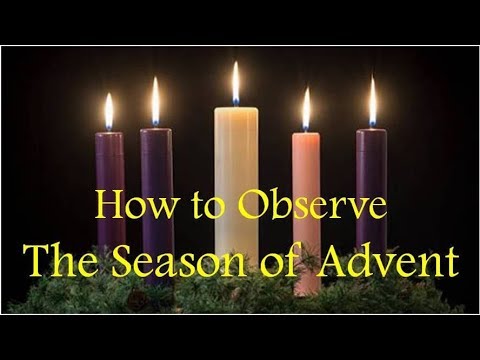
Advent is frequently a misunderstood season today, and thus often not fully experienced.  It is typically reduced to wreaths, candles, and a countdown to Christmas (or, even a sort of prolonged "pre-function" to Christmas) involving chocolate-filled calendars. It is far more than that. Advent is a complex season with multiple dimensions and a strong call to engage in repentance -- yes, repentance.

This ispenitential season – despite the occasional cavil from more recent liturgical experts – but not in the same way as Lent. Advent’s preparation for the Feast of the Nativity of Christ is marked by a high degree of eschatological expectation, for Advent is really a preparation for two “comings” of Christ: his “coming amongst us in great humility” as the Collect for the First Sunday of Advent says and which we celebrate at Christmas, and “when he comes again in majesty to judge both the quick and the dead” at the Last Judgement. Both require serious and considered preparation. This is why St. John the Baptist and his urgent call to prepare for the coming of the Lord features so strongly in the readings, prayers, and hymns for these weeks.


Because true Christian belief and practice about the Last Judgement is founded upon hope and joy (rather than fear and anxiety), any sense of trepidation about the “Last Things” is a sign that we have spiritual work to do – and who among us is free from this ongoing work “now in the time of this mortal life” as the great Advent Collect puts it? Advent, with its focus on expectation and preparation, naturally serves as a time to consider what needs repentance and reconciliation in our life. 


This is all very well to say, but how do we respond?  The Prayer Book provides some clear direction.


First, there is the matter of examining our conscience.  By engaging in this practice, we are led to see what the Holy Spirit is prompting us to address at this juncture in life.  Tools for this work abound in the Book of Common Prayer:

·      The Ten Commandments (from the Penitential Order in the Holy Eucharist)

·      The Summary of the Law (from the same place)

·      The five baptismal promises found in the Baptismal Covenant (in the Baptismal liturgy)

·      The Litany of Penitence (from the Ash Wednesday liturgy)

·      The Great Litany

·      The Catechism

·      The Psalms & Collects


There are, of course, many other tools for examining our conscience (reading from the Sermon on the Mount is one, or one might use one of the traditional forms found in such non-BCP resources as The St. Augustine’s Prayer Book).


Once we have spent time in careful consideration about what is at issue, it then follows that we confess to God our sins and receive assurance of God’s pardon.  In the Anglican and catholic tradition of the faith, there are three such forms: Private Confession, General Confession, and Sacramental (auricular) Confession.


Private Confession is what we do on a daily basis in our own private prayers. It is often how we approach the Confession in Morning / Evening Prayer or the bedtime service of Compline when said alone (though, one must always remember, these services are always liturgical services and thus part of the whole Church's offering, even if said alone).  


This is our regular application of what Jesus teaches in the Lord’s Prayer: “Forgive us our trespasses as we forgive those who trespass against us.”  Confessing our sins to God should be a natural part of life – not as an act of shame or scrupulosity, but openness and candor with our God. It may be done at any time and it is indeed good to become able to confess quickly, just as the Lord's Prayer suggests. It will help up learn to forgive others quickly, as well.


General Confession takes place in community, in the context of Morning or Evening Prayer when gathered in church, or at the Holy Eucharist as we prepare to receive the Holy Mysteries of Christ.  It reminds us that sin is never a purely private matter (a “victimless crime”), but always impairs our relationships with both God and neighbor.  


This form of confession is closer to how the earliest Christians confessed their sins to one another, and thus connects us to the ancient Church’s pattern of acknowledging sin as a body.  It is also an important (essential) part of participating in public worship and particularly in receiving the Holy Sacrament.  One other point: General Confession is followed by the priest/bishop pronouncing an assurance of pardon, making clear that our confession and repentance is predicated on God’s mercy eternally offered in Christ's death upon the cross; the ordained minister is not a magical pipeline of that forgiveness: it is a declaration of that eternal al forgiveness over God’s penitent people assembled for worship.


Finally, there is Sacramental or Auricular Confession.  Here, a penitent confesses to God and the Church in a private manner – with only a priest present.  This form of confession is especially appropriate for sins of a serious nature, for old sins which have long continued to plague one’s conscience, for relapses into past patterns, at the end of life or when preparing for confirmation, marriage, ordination, or other major changes in our life, or when God’s forgiveness seems far away.  


Sacramental Confession is a part of the Church’s healing ministry and is directly connected to our baptism.  It is essentially spiritual medicine and may be received either at posted times in the church’s schedule, or by special arrangement with the priest.


Advent’s brevity is actually one of its best features: it makes clear that the time for setting our house in order is limited, and that God awaits our cooperation for our healing and renewal.  The joyful expectation which marks the season is also a summons to enter into this work with alacrity and zest: God desires our freedom and has come amongst us to secure it.  It is now time for us to respond by discernment and repentance so that we may enter more fully into the joy set before us – a joy begun at Christ’s nativity and culminating in the final “setting to rights” of all things in the love and truth of Christ’s return.


Let us all make this Advent season now begun a profitable season of spiritual renewal and restoration, “now in the time of this mortal life.”  By entering into a careful consideration of our conscience and appropriate repentance, followed by confession in the full assurance of God’s loving pardon, we may come to Christmas with a greater joy and a less burdened heart, ready to celebrate and live with our eyes firmly fixed on that day when, by God’s grace, “we may rise to the life immortal,” already begun in our life in Christ now.


Almighty God, give us grace that we may cast away the

works of darkness, and put upon us the armor of light, now

in the time of this mortal life in which thy Son Jesus Christ

came to visit us in great humility; that in the last day, when

he shall come again in his glorious majesty to judge both the

quick and the dead, we may rise to the life immortal; through

him who liveth and reigneth with thee and the Holy Ghost,

one God, now and for ever.  Amen.