Showing posts with label Through the Church Year; Eschatology. Show all posts

Monday, November 27, 2023

Between Thanksgiving and Advent...


This can be a confusing period of time--as this book cover suggests.

As we end November and approach December the civil and church calendars coexist in a somewhat unusual manner in the U.S.  Often, Thanksgiving Day is the immediate herald of Advent, but November has five Thursdays this year (Thanksgiving currently is the fourth Thursday of November, not the last Thursday of the month), and this gives a longer-than-usual gap between the culmination of the fall and the start of the Church’s preparation for Christmas—time available for consideration and use in the spiritual life.

Under the current (1979 BCP) version of the Church Year, the last weeks of the annual cycle focus on themes of judgement, harvest, completion, and the consequences of time meeting eternity.  These traditional Advent themes are, in effect, stretched out into something like a preamble to that season, emphasizing the elements of our faith summed up in the creeds around the “Judgment of the quick and the dead.”  This includes a healthy dose of eschatology and its intensity--the "secret sauce" of all authentic Christianity.


This emphasis allows Advent itself to be focused largely on joy—both the joy of Christ’s first coming (Incarnation/Nativity) and the joy of his second coming at the end of the ages.  This is different from prior calendars which tended to look at Advent in more explicitly penitential ways.


Because so much of Western Christianity’s understanding of eschatology has been built on fear, terror, remorse, shame, and condemnation, the other side of the coin is rarely considered.  The form Advent now takes in our calendar is less about The Four Last Things of death, judgment, heaven, and hell, and more about living in such a way that we will hear with joy the words “Behold, the Bridegroom comes!” at the end of time.


The biblical figures we focus on in the coming season are: the prophet Isaiah, the Prophet of the Advent; Christ’s Forerunner, St. John the Baptist; and the God-bearer, St. Mary the Virgin.


Isaiah prepares us for God’s shocking action of bringing the Messiah to us; the Baptist heralds the Messiah’s arrival, and the Blessed Virgin consents to God’s election and bears the Christ-child so that God may share in our life and redeem it “from within,” so-to-speak.


Through all of these weeks, the two aspects of our redemption—the proving, testing fire of judgment and the comforting, healing embrace of love—are explored and shown to be but two sides of the same coin.  To dwell in the Kingdom of God means an entrance into the divine presence and our true selves, an entrance in which all sin is ultimately consumed and all distortion stripped away in the ravishing, glorious totality of God’s love.  This is at the heart of authentic eschatology and forms a major part of the preacher’s and teacher’s work in this part of the Church Year.


Most years, all of this happens in quick succession—The last Sunday after Pentecost, with its imagery of judgement and enthronement being followed by the harvest thankfulness of Thanksgiving Day and then almost immediately by Advent Sunday’s proclamation of “Sleeper’s, Awake!”


This rapidity is as it should be, really.  The scriptures testify that God’s judgement will be sudden, not a bureaucratic “process” involving lots of forms and delays, nor a test we “study up” for.  Yet, the insertion of an extra week from time-to-time (as with this year) does afford us the opportunity to consider a couple of thoughts: God’s mercy in allowing time to repent, and the difference between judgement and simple retribution.


This extra space of time between Thanksgiving/The Last Sunday after Pentecost and Advent Sunday is a reminder that God often grants us time to draw back and change direction.  This space for repentance is one of the many ways God shows mercy, and something to give thanks for, always.


The other point I would like to make about this week is that it shows how God’s judgement is a considered matter, a revealing of our journey, intentions, and purposes, rather than mere retribution or spite.  


The parables of judgement in the Gospel are not about a capricious deity just showing off power for power’s sake, but the working out of consequences of deeds done (or not done).  


We can go for long periods without thought to the kind of life we are building, but all the while, we are still building it.  That is our “life project,” and it is the offering we will make at the end of our earthly pilgrimage.  The space between these parables of judgement and Advent Sunday is a good time to think seriously about the nature of that offering, and how we may use this Advent season to renew and re-form that offering so it may be worthy of the eternity on the edge of which we stand this season—and every day—as members of Christ’s body.


Enjoy this week, and use it wisely!

Friday, December 2, 2022

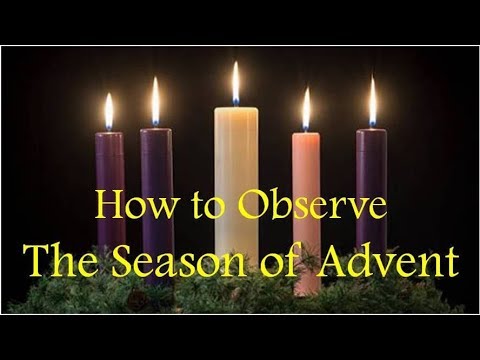
Advent, Repentance, and the Prayer Book’s Way of Preparation: It's More than a Wreath

Advent is a season of beauty, expectation, and penitence.

Advent is frequently a misunderstood season today, and thus often not fully experienced.  It is typically reduced to wreaths, candles, and a countdown to Christmas (or, even a sort of prolonged "pre-function" to Christmas) involving chocolate-filled calendars. It is far more than that. Advent is a complex season with multiple dimensions and a strong call to engage in repentance -- yes, repentance.

This is a penitential season – despite the occasional cavil from more recent liturgical experts – but not in the same way as Lent. Advent’s preparation for the Feast of the Nativity of Christ is marked by a high degree of eschatological expectation, for Advent is really a preparation for two “comings” of Christ: his “coming amongst us in great humility” as the Collect for the First Sunday of Advent says and which we celebrate at Christmas, and “when he comes again in majesty to judge both the quick and the dead” at the Last Judgement. Both require serious and considered preparation. This is why St. John the Baptist and his urgent call to prepare for the coming of the Lord features so strongly in the readings, prayers, and hymns for these weeks.


Because true Christian belief and practice about the Last Judgement is founded upon hope and joy (rather than fear and anxiety), any sense of trepidation about the “Last Things” is a sign that we have spiritual work to do – and who among us is free from this ongoing work “now in the time of this mortal life” as the great Advent Collect puts it? Advent, with its focus on expectation and preparation, naturally serves as a time to consider what needs repentance and reconciliation in our life. 


This is all very well to say, but how do we respond?  The Prayer Book provides some clear direction.


First, there is the matter of examining our conscience.  By engaging in this practice, we are led to see what the Holy Spirit is prompting us to address at this juncture in life.  Tools for this work abound in the Book of Common Prayer:

·      The Ten Commandments (from the Penitential Order in the Holy Eucharist)

·      The Summary of the Law (from the same place)

·      The five baptismal promises found in the Baptismal Covenant (in the Baptismal liturgy)

·      The Litany of Penitence (from the Ash Wednesday liturgy)

·      The Great Litany

·      The Catechism

·      The Psalms & Collects


There are, of course, many other tools for examining our conscience (reading from the Sermon on the Mount is one, or one might use one of the traditional forms found in such non-BCP resources as The St. Augustine’s Prayer Book).


Once we have spent time in careful consideration about what is at issue, it then follows that we confess to God our sins and receive assurance of God’s pardon.  In the Anglican and catholic tradition of the faith, there are three such forms: Private Confession, General Confession, and Sacramental (auricular) Confession.


Private Confession is what we do on a daily basis in our own private prayers. It is often how we approach the Confession in Morning / Evening Prayer or the bedtime service of Compline when said alone (though, one must always remember, these services are always liturgical services and thus part of the whole Church's offering, even if said alone).  


This is our regular application of what Jesus teaches in the Lord’s Prayer: “Forgive us our trespasses as we forgive those who trespass against us.”  Confessing our sins to God should be a natural part of life – not as an act of shame or scrupulosity, but openness and candor with our God. It may be done at any time and it is indeed good to become able to confess quickly, just as the Lord's Prayer suggests. It will help up learn to forgive others quickly, as well.


General Confession takes place in community, in the context of Morning or Evening Prayer when gathered in church, or at the Holy Eucharist as we prepare to receive the Holy Mysteries of Christ.  It reminds us that sin is never a purely private matter (a “victimless crime”), but always impairs our relationships with both God and neighbor.  


This form of confession is closer to how the earliest Christians confessed their sins to one another, and thus connects us to the ancient Church’s pattern of acknowledging sin as a body.  It is also an important (essential) part of participating in public worship and particularly in receiving the Holy Sacrament.  One other point: General Confession is followed by the priest/bishop pronouncing an assurance of pardon, making clear that our confession and repentance is predicated on God’s mercy eternally offered in Christ's death upon the cross; the ordained minister is not a magical pipeline of that forgiveness: it is a declaration of that eternal al forgiveness over God’s penitent people assembled for worship.


Finally, there is Sacramental or Auricular Confession.  Here, a penitent confesses to God and the Church in a private manner – with only a priest present.  This form of confession is especially appropriate for sins of a serious nature, for old sins which have long continued to plague one’s conscience, for relapses into past patterns, at the end of life or when preparing for confirmation, marriage, ordination, or other major changes in our life, or when God’s forgiveness seems far away.  


Sacramental Confession is a part of the Church’s healing ministry and is directly connected to our baptism.  It is essentially spiritual medicine and may be received either at posted times in the church’s schedule, or by special arrangement with the priest.


Advent’s brevity is actually one of its best features: it makes clear that the time for setting our house in order is limited, and that God awaits our cooperation for our healing and renewal.  The joyful expectation which marks the season is also a summons to enter into this work with alacrity and zest: God desires our freedom and has come amongst us to secure it.  It is now time for us to respond by discernment and repentance so that we may enter more fully into the joy set before us – a joy begun at Christ’s nativity and culminating in the final “setting to rights” of all things in the love and truth of Christ’s return.


Let us all make this Advent season now begun a profitable season of spiritual renewal and restoration, “now in the time of this mortal life.”  By entering into a careful consideration of our conscience and appropriate repentance, followed by confession in the full assurance of God’s loving pardon, we may come to Christmas with a greater joy and a less burdened heart, ready to celebrate and live with our eyes firmly fixed on that day when, by God’s grace, “we may rise to the life immortal,” already begun in our life in Christ now.


Almighty God, give us grace that we may cast away the

works of darkness, and put upon us the armor of light, now

in the time of this mortal life in which thy Son Jesus Christ

came to visit us in great humility; that in the last day, when

he shall come again in his glorious majesty to judge both the

quick and the dead, we may rise to the life immortal; through

him who liveth and reigneth with thee and the Holy Ghost,

one God, now and for ever.  Amen.


Saturday, November 19, 2022

A Different Kind of King: The Last Sunday after Pentecost


Almighty and everlasting God, whose will it is to restore all things in your well-beloved Son, the King of kings and Lord of lords: Mercifully grant that the peoples of the earth, divided and enslaved by sin, may be freed and brought together under his most gracious rule; who lives and reigns with you and the Holy Spirit, one God, now and for ever. Amen.


The last Sunday of the Church Year in the current calendar emphasizes humanity’s need for salvation.  It speaks of our kind being “divided and enslaved by sin,” and prays that we may all be “freed and brought together.” Ah, but exactly how?


The desire to conform the divided and contentious human race to a single standard and rule is an ancient one, fueling millennia of empires, wars, intrigues, and revolts.  It has also led to some of the greatest art and literature humans have produced.  The difficulty is that the usual attempt at uniting peoples has been through force or coercion – which ends up just bringing us to the next chapter in division, enslavement, and alienation.


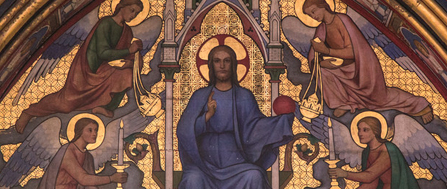
This Sunday gives God’s response to our need for salvation, healing, and freedom: Christ Jesus, a different kind of king. 


When the earliest Christians began calling Jesus “Lord,” they were being quite specific in this term of address.  Using a title reserved for earthly rulers (and, in the Roman world, for only one ruler – you know who) revealed Christians as a dangerous and subversive community of people.  In an empire built on force and coercion, the Christian Church exalted service, self-sacrifice, and meekness – as did its Lord Jesus. The currency of this rival empire was in an untried coinage, one which did not take death as its starting and ending point: the coinage of love.


In addition to positing a higher loyalty than the to the Emperor, this alternative vision for humans was utterly despicable to those who were invested in the world-as-it-is.  As Jesus had predicted, his Gospel brought conflict with the Powers that Be, who quickly decided that they must stamp the mutiny out.


As long as humans think that true freedom or peace can be found at the end of a gun’s barrel, or by putting a boot on someone’s neck, we will be caught in the cycle of insanity that is recorded history.  When any of us, even for a season, step out of that cycle and put into practice the Gospel vision for freedom and peace – this Sunday expressed in the words of the crucified Christ: "Father, forgive them; for they do not know what they are doing”– by praying for one’s enemies and by handing over all hatred, judgment, and condemnation to the only one who sees all things in truth, then for that moment and in that place the Kingdom of God is present.  Fleeting, perhaps, but present.  For a moment, the lie is overcome in truth.


This final Sunday of the Church Year reminds us that no other solution to the conundrum of human brokenness will, in fact, work. Only Christ’s “most gracious rule” can give the freedom and peace we desire. Only his peculiar lordship, one completely devoid of a desire to coerce, will unite a divided world. Try as we might to avoid it, this is humanity’s destiny. It is what we proclaim in our faith, what we enact in our worship, and what we are challenged to practice in our daily lives. 


Thursday, November 18, 2021

The Last Sunday


Next Sunday's liturgical title is: "The Last Sunday after Pentecost." It has a rather jarring quality to it. The Last Sunday. It makes one think of finality and culmination.

Due to the collect for this Sunday and the imagery often used in both the scriptures appointed and hymns chosen, it is frequently called "Christ-the-King," though the BCP nowhere actually names it thus.

The "Feast of Christ-the-King" was instituted by the Roman Catholic Church in the 1920s in response to growing secularization, the effects of nationalism, and (to be honest) the decline in monarchies in favor of democracies, communism, or dictatorships. Originally appointed in that Church for the Sunday before All Saints' Day, it emphasized Christ's sovereignty above other loyalties and ideologies--something very much worth consideration now, as well.

Many Episcopalians now prefer "The Reign of Christ" to "Christ-the-King" for this day, largely for its avoidance of patriarchal / hierarchichal / masculine imagery for Christ. Yet, the debate over this Sunday's "nickname" tends to obscure its actual message.

What this Sunday celebrates is not substituting one form of earthly power (monarchy for democracy) for another, but the coming victory of God's reign on earth--something we pray for each time we say the Lord's Prayer and the Creeds. Simply put, this Sunday celebrates a world we pray for but often seem at odds with.

Such a world is not based on death, fear, or shame. It is lived in light, love, and joy. It bridges divides we think impossible; it raises up the lowly, and brings down the haughty. It reveals the truth about God, humans, and the creation. God's restored world is utterly unexpected by and completely at odds with "the way things are." Through the gift of the Holy Spirit it is available to us in holy creation, in liturgy, in prayer, and in Christian service with others made in God's sacred image.

Whenever we meet with it--even for a moment--we will find Christ's reign strange and challenging to the exact degree we are wedded to death. It is for this reason that this Sunday's Gospel reading highlights the dialogue between Pontius Pilate and Jesus Christ: a conversation between death and Life itself.

This Sunday is a frank admission that placing our loyalty in "the way things are" or in our own "devices and desires" is in direct opposition to Christ's reign, his will as made known in the gospel. It points to the conflict at the heart of being a Christian.

It has been observed that, for one to catch the feeling of authentic Christianity, one must understand every day to be our last. Only then will the preciousness and sacredness of each day be revealed. "The Last Sunday after Pentecost" catches that very well. True Christianity means we have already died and risen with Jesus and are thus citizens of God's dominion, God's sacred community. Our loyalties, priorities, and desires must and will be tested again and again, until we gladly surrender to this.

As we come to this Sunday, I pray we will each experience it truly as "The Last Sunday": consciously standing on eternity's edge and preparing to fall lovingly into Christ's arms of love and truth.

For, in truth, that is what this Sunday (and every day) should be--the eternally glorious moment of surrender to the Love which alone makes right, and which alone overcomes death, fear, and loss.


Brandon+