Showing posts with label Church in the World. Show all posts

Friday, August 1, 2025

Vacation Thoughts on Worship

Emptiness in the Church can mean more than the obvious...

When clergy go on vacation and worship elsewhere it is likely they will form some opinions about what they experience. I'm certainly no exception to this. While I try not to abstract myself from the act of worship, it is difficult as a priest and pastor not to look at the apparent assumptions manifest in the public life and liturgy of various churches--their imagery and emphasis as well as their character and "tonality." This allows me to look beyond the admittedly small boundaries of the parish in which I serve, but also to reflect on my own assumptions and practices.

One of the things I often experience while worshipping in a new setting is the question regarding whom we are addressing when we pray. Quite often it seems the prayers, hymns, and actions of worship are really being directed toward each other rather than God. Sometimes it is the slipshod way prayers are read, or the posture used (almost invariably directed toward the people in Western Christian churches, aside from a few High Church hold-outs), or blasé attitude taken by the congregation. Taken together there is the strong sense that when we gather the focus is on us, not the transcendent God. The teaching about liturgy being the work of worship of God by the people has sunk to a focus largely on the people.

Decades of emphasis on immanence, accessibility, and so-called relevance (a non-negotiable concept, yet one never really explained in theological or scriptural terms) has left many clergy and lay leaders bereft of understanding, talent, or skill in leading the people's praises. This, in turn, makes not for worship but entertainment--and all that means in an attention economy. 

In my own tradition this results in clergy who cannot use the materials of the liturgy with any degree of facility (thus drawing the attention to themselves) and lay leadership, utterly unfamiliar with the skills associated with their role through lack of training, spitballing their way through worship and inventing various folksy customs devoid of theological coherence or spiritual depth. It is often a few older people and some of the longtime church musicians alone who provide any respite from the relentlessness of this empty relevance, and I thank the Lord for them.

The upshot is that many churches today, long conformed to secular notions of success and relevance, "produce" worship which is not terribly transformative nor awfully substantial. This results in a case of "hiding one's light underneath a bushel basket" by veiling the liturgy in consumerist terms. With most churches simply not up to offering even very effective entertainment, the outcome is a bland clubbiness acceptable to some weary Boomers and Gen-X'ers vaguely remembering past church associations but utterly irrelevant (to turn the word around) for many younger people who are looking not only for a soothing or easy welcome leading nowhere in particular, but for an encounter with God, New Life in Christ, and a substantial banquet of teaching, practice, and community to provide meaning and substance absent in their secular life.

As long as I have been ordained (which is getting to be a good long while now) I have seen this mindset grip the American Christian scene. Many church traditions (including my own, sadly) seem still to be in the thrall of this misunderstanding. While there are some fine exceptions, it takes a great deal of energy, skill, and focus to resist the officially-sanctioned trend toward self-worship and immanence-overload. 

Some church traditions are far more resistant to this mutilation of worship, of course, but most are not. And, as long as there are a large number of people committed to the project of relevance-at-all-costs, there can be little opportunity for real consideration and change. For such people, no amount of decline in their church tradition (or growth and effectiveness in other traditions) will ever shake their commitment to this outdated and banal strategy. The grave alone will wrest what is left of their church communities from their doctrinaire, implacable hands.

I don't expect this post to change anything, nor do I consider it a thunderbolt of insight, but I place it here to mark a spot on the Internet where the standards of the day are not winked at, ignored, or shrugged off. Our calling is, in the words of 1 Peter 2:9, to be "a chosen people, a royal priesthood, a holy nation, God’s own people," in order that we may proclaim the excellence of him who called us out of darkness into his marvelous light. The worship we offer and the communities we foster should reflect this rather than turn our back on it.

Saturday, October 28, 2023

"That All Who Seek You Here May Find You..."


Almighty God, to whose glory we celebrate the dedication of this house of prayer: We give you thanks for the fellowship of those who have worshiped in this place, and we pray that all who seek you here may find you, and be filled with your joy and peace; through Jesus Christ our Lord, who lives and reigns with you, in the unity of the Holy Spirit, one God, now and for ever.  Amen.


This Sunday St. Timothy’s will observe one of its two Parochial Feasts: the dedication of its church (the other is its “feast of title,” the commemoration of St. Timothy in January). This annual event recalls the dedication liturgies in this parish’s history: of the first church building (now our parish hall), of the second (and current) nave, and of the educational, office, and chapel addition in 1997.


This liturgy has several special characteristics. First of all, it is a feast with its own collect, lessons, prayers of the people, and hymns. It opens with a Festal Procession, with a collect at  a station where the icon of our  patron St. Timothy is displayed. The Gloria in excelsis, the great hymn of praise from the early Christian era reserved for major feasts, is sung as the altar is censed. Deceased benefactors and members of St. Timothy’s are recalled in our prayers. Finally, before the liturgy concludes, a solemn Te Deum is sung, giving God especial thanks for this house of prayer as a guaranteed place of meeting and as a center of mission. So much for the liturgical details.


What must be of greater concern for us is the meaning behind this feast and its special elements, for the liturgy is a direct participation in the mystery of God the Holy Trinity, and a showing forth of the Kingdom of God, dawning even now in its fullness by the action of the Holy Spirit. What, then, does this liturgy signify to us?


The collect for the feast puts two things front-and-center: communion and its fruits. The Feast of Dedication is a thanksgiving for communion in its many forms: fellowship with God, fellowship with other disciples, fellowship with those who have already entered eternal life. It is also a plea to God that this parish—holy ground, dedicated to God’s way, God’s presence, a kind of divine beachhead in our agonized and strife-torn world—may always be a place where people may find God and be filled with divine joy and peace.


Ours has become a “desacralized” world; that is a fancy word for the condition of having little or no holiness. In its place, we have tried to substitute the material, the commercial, the purely physical, or the ideological. All around us we see the grotesque results of this experiment: addictions, obsessions, environmental degradation, the commodification of human life, industrialized killing, and the reduction of mystery and awe to such slogans as “follow your bliss”, “it’s all good”, or the demand for conformity to a particular political party or opinion. The hunger for something more is being bought off—temporarily—by a less and less effective array of consumerist and ideological stop-gaps. 


But the Church has the one thing that will satisfy that hunger: communion with God, with the creation, and with each other. Here, in this place, the cheap and sleazy answers the world hands out are not offered. Here, the utter connectedness of all things to their God is revealed. Here joy and peace are not just words: they are the currency of our shared life. Each Eucharist is a joyful renewal of that fact, reaching out beyond the buildings of St. Timothy’s into the lives of its members throughout this city and its surroundings.


The Feast of Dedication is no self-congratulatory party wherein this parish looks admiringly at itself in a mirror. It is a thanksgiving for the grace of God leading to the foresight, sweat, and sacrifice of those who came before us to bring about this parish’s physical presence. But it is more than that: it is a rousing call to take seriously the preciousness of Holy Ground in a city where hope, justice, peace, relationships, and even human life have become just words. 


Here, at this place, the Kingdom of God is made known at each Eucharist, in each class or parish event. Here, those who seek God are able to find him: imperfectly, yes—but find God we may. For the Lord has blessed it, set it apart, making it a portal through which all may enter and be restored, refashioned into what we were created to be from the foundation of the world: the Royal Priesthood of Creation.


Let us give thanks for the dedication of this parish and live out its promise. Like all churches who retain zeal for the Kingdom of God, it is a beacon of hope in a world awash in turmoil, anxiety, and fear.

Wednesday, August 31, 2022

St. Aidan & the Seeds of Renewal Today


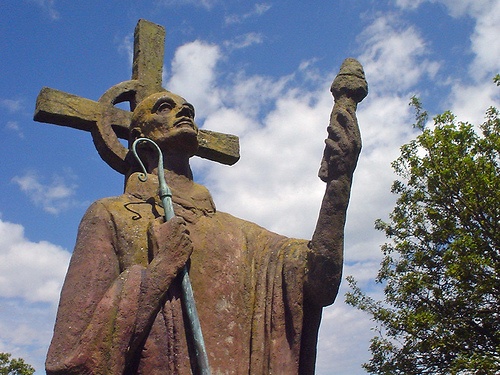
Today is the feast of St. Aidan of Lindisfarne, who entered into eternal life in AD 651.  He is often called "the Apostle to the English."  His statue on the holy island of Lindisfarne shows him bearing a torch, bringing light to a world mired in spiritual darkness, magic, oppression, and anxiety.  This shows the Church's task and setting remain essentially the same in every age.

Aidan was sent from that other "holy isle" in the Celtic north (Iona) to try and restart a failed mission led by a previous monk. This monk had spoken down to everyone, was of an irascible temper, and seemed to feel that people needed to come to him rather than he going out to them. He also thought that the Gospel could be propagated by spending his time with the "influencers" and powerful in Northumbria rather than with the ordinary folk. As a way of sharing New Life in Christ, it bombed.

Aidan essentially turned this model upside-down -- which is pretty much what authentic Christianity always does to so-called "normal" strategies of human power and invention.

He spoke humbly and with openness, not cloaking himself in arrogance or "know-it-all-ism." He was gentle in manner yet clearly revealing an inner strength and groundedness in kindness and Truth different from the magicians and wizards. He addressed real problems of poverty and slavery rather than consigning everything to unseen forces and talking in airy platitudes.

He walked everywhere (not using horses, then the symbol of power in transit) and spoke with everyone, high or low. This unnerved some of the high-ups in that very stratified society but it immediately struck the common people and opened doors to Aidan's message his predecessor could never have imagined. The results were spectacular. A form of Christianity -- rooted in the culture and practices of that place and time -- grew rapidly and without coercion. Eventually, an entire crop of holy people were produced in the next generation, which is always a sign God's blessing.

Aidan wasn't concerned with building an institution or a success-machine. In this way he differed from many who claim to follow Christ today, where the focus so often goes to the trappings of success and acknowledged achievement rather than true renewal of the person and the world around us.

Renewal of the Church has never really been the point of Christian mission. The Church is Christ's Body and has already been made glorious in Christ's resurrection and ascension, and through the giving of the Holy Spirit at Pentecost. The Church is forever alive, forever victorious over death, forever new. What isn't is the way the Church often goes about its work.

Much of the last century in our country the Church has acted rather like Aidan's failed predecessor: talking down to those outside, hanging out with elites, and being concerned with symbols of power rather than being like Christ in humility and simplicity. Aidan's witness so many centuries ago is memorable because of how it overturned merely human logic with divine love and unexpected freedom. 

What is needed today in the Church is not more relevance and techniques (read: success and control) but more servanthood, listening, and sharing from the treasury not of political/cultural power by ancient and ever-new wisdom -- the wisdom of God. This will, of course, sometimes lead to conflict not only with the "powers that be" but also those who are dedicated to ideologies opposed to the Gospel -- especially those which clothe themselves in "church-talk" while actually being predicated on sin. Yet, such a way of living inevitably attracts those who desire what Jesus, rather than Caesar, has to offer. We must simply be patient, focused, and undistracted in our work.

Such are the seeds of authenticity and simplicity Aidan brought to Northumbria well over one thousand years ago, and these are the seeds of renewal we must tend today.

The Collect for St. Aidan of Lindisfarne

O loving God, you called your servant Aidan from the cloister to re-establish the Christian mission in northern England: Grant that we, following his example, may use what you have given us for the relief of human need, and may persevere in commending the saving Gospel of our Redeemer Jesus Christ; who lives and reigns with you and the Holy Spirit, one God, for ever and ever. Amen.
  

Monday, August 29, 2022

The Martyrdom of St. John the Baptist: Telling the Truth


August 29 is the commemoration of the beheading of St. John the Baptist. It is a solemn day, with a story well-attested in the Holy Scriptures, long honored by the Church (though only recently recognized by the Episcopal Church, for some reason).

The Holy Forerunner's death is deeply connected to the story of his nativity (June 24) and the his father Zechariah's prophesy in Luke. It is also directly connected to Christ's nativity and our Savior's embodiment of Truth. We encounter the Baptist's significance and ministry each time we pray the Benedictus Dominus Deus at Morning Prayer -- which, depending on which canticle one uses, could be just about each morning.

Throughout the year, John plays a central part in the story of salvation. In Advent he heralds the coming Messiah by calling all to repent and prepare. His baptism of Christ is central to the entire logic and purpose of Epiphanytide. His boldness and proclamation of repentance is recalled again in Lent. His promise that the One he heralds will bring the Holy Spirit with fire binds Advent to Pentecost.

This omnipresence in the Church year mirror's John’s centrality to the Gospel narrative, from the beginning of Mark through the opening of the Book of Acts. His fierce insistence on divine truth and faithfulness in the face of earthly power is a foundation on which Jesus built and upon which the Christian Church’s ministry of prophetic witness flourishes. Because of his utter fidelity to God’s call, he died a martyr’s death – prefiguring Christ's death at the hands of unjust leaders, as well as the countless other who follow in his footsteps to this day.  Indeed, our day has seen the making of a vast number of martyrs, many beheaded in much the same manner as the Blessed Forerunner -- hidden away in dungeon and "secure locations."

John's witness with regard to the interaction of faith and political power speaks to us in especially potent ways today. His uncompromising commitment to telling the truth in the face of overwhelming secular power sets the standard for authentic Christian life -- and shows how weak and hypocritical many in the Church (lay and ordained, then and now) are when dealing with "the powers that be" when the Church becomes enmeshed with the "power of the sword."

When John said to Herod “you cannot have her” with regard to Herod’s liaison with Herodias, the wife of his brother Herod Philip, it was too much. John was just possibly endurable when he was taking on the religious leaders, but here he was crossing the line into the lane where the traffic is fast and unmerciful. Herodias, tired of Herod’s anxious shilly-shallying about John, wanted this meddling holy man dead and found a way to achieve it. Using the occasion of a drunken birthday party, she slyly planted her daughter as dancing bait for Herod’s inebriate lust. Wildly making public promises of largesse, Herod was in her debt…and Herodias's daughter took him down like an experienced hustler takes down a green rube just off the bus from Nowheresville. In the time it took for the music to stop, Herod was in over his head, and John was without his. The message was clear: Don’t get in the way of powerful people when reputation, politics, and personal cred are on the line. This is ever the case.

The portrait of arrogance, privilege, decadence, and drunkenness emerging here is remarkably appropriate to current events. With so many Christians being willing to go along with Herod's "might-makes-right" reasoning, and with nearly idolatrous levels of support given to politicians very much Herod's kin in terms of behavior by many "Christian" leaders as well as the rank-and-file, one could well imagine John the Baptist's head being lopped off with their quiet nod today. He would have to go, you see: he made the base angry.

The teaching potential of this holy day is great. It shows that to confront evil, we need endurance. Sometimes, it seems that evil actually wins; but its victory—like Herodias’s -- is only apparent. In reality, God’s power and truth is finally completely victorious. It survives continual assault as a vision and a desire. God's vision will forever keep popping up, no matter how many are "cancelled" by silencing or decollation. 

What is needed is an ongoing commitment to Gospel justice, even in the face of evil’s awful array of violence, lies, distortion, and corruption. To the last drop, the last moment, the last sentence, St. John the Baptist witnessed to such a commitment. This is why we keep this day.

This day reminds us that by following Jesus Christ as Lord (whom John heralded), we share in this revolutionary ministry of truth-telling. 

If we in the ordinary congregations of the Church take this vocation seriously, maybe even the so-called "leaders" of a heavily-compromised American Christianity follow the Holy Truth-Teller until the day when all lies are exposed and all elites humbled. Then the tragedy of this day will be crowned with true glory. As it is, we journey on in hope and faithfulness.


A Collect for the Martyrdom of St. John the Baptist

God our Father, you called John the Baptist to be the herald of your Son's birth and death. As he gave his life in witness to truth and justice, so may we strive to profess our faith in your Gospel. Grant this through our Lord Jesus Christ, your Son, who lives and reigns with you and the Holy Spirit, one God, for ever and ever. Amen.

Friday, September 18, 2020

Merton on the Internet (?)


Here is a section from Thomas Merton’s 1961 New Seeds of Contemplation. It originally dealt with the media and culture of that era, but I have made changes by putting it – I trust without too much violence to the author’s intent – into the current era’s language regarding gender and technology. I believe this chapter (12) to be one of the most useful in that excellent book.


As a pastor, I find an ever-increasing connection between how much / what type of internet use a person has and the state of the soul. This is shaping up to be one of the great spiritual issues of our era. Like you, I wrestle with this issue almost daily. The point that we keep wrestling.


You will never find interior solitude unless you make some conscious effort to deliver yourself form the desires and the cares and the attachments of an existence in time and in the world.


Do everything you can to avoid the noise and the business of society. Keep as far away as you can from the places where people gather to cheat and insult on another, to exploit one another, to laugh at one another, or to mock one another with their false gestures of friendship. Be glad if you can keep beyond the reach of their radios, videos, and websites. Do not bother with their unearthly songs, tweets, and memes. Do not read their advertisements.


The contemplative life certainly does not demand a self-righteous contempt for the habits and diversions of ordinary people. But nevertheless, no one who seeks liberation and light in solitude, no one who seeks spiritual freedom, can afford to yield passively to all the appeals of a society of salespeople, advertisers, and consumers. There is no doubt that life cannot be lived on a human level without certain legitimate pleasures. But to say that all the pleasures which offer themselves to us as necessities are now “legitimate” is quite another story. A natural pleasure is one thing; and unnatural pleasure, forced upon the satiated mind by the importunity of a salesperson is quite another.


It should be accepted as a most elementary human and moral truth that no one can live a fully sane and decent life unless able to say “no” on occasion to natural bodily appetites. No one who simply eats and drinks, whenever feeling like eating and drinking…who gratifies curiosity and sensuality whenever they are stimulated, can be considered a free person….You aren’t “sinning” but simply making an ass of yourself, deluding yourself that you are real when your compulsions have reduced you to a shadow of a genuine person.


In general, it can be said that no contemplative life is possible without ascetic self-discipline. One must learn to survive without the habit-forming luxuries which get such a hold on people today. I do not say that to a be a contemplative one has to go without alcohol or a computer, but certainly one must be able to use these things without being dominated by an uncontrolled need for them. There can be no doubt that surfing the internet and drinking are obvious areas for the elementary self-denial without which a life of prayer would be a pure illusion.


I am certainly no judge of the internet, since I have never used it. All I know is that there is a sufficiently general agreement, among people whose judgment I respect, that much of the internet is degraded, meretricious, and absurd. Certainly it would seem that it could become a kind of unnatural surrogate for contemplation: a completely inert subjection to vulgar images, a descent to a sub-natural passivity rathe than an ascent to a supremely active passivity in understanding and love. It would seem that the internet should be used with extreme care and discrimination by anyone who might hope to take interior life seriously.


Keep your eyes clean and your ears quiet and your mind serene. Breathe God’s air. Work, if you can, under His sky.


But if you have to live in a city and work among machines and ride in the subways and eat in a place where the radio makes you deaf with spurious news and where the food destroys your life and the sentiments of those arounds you poisons your heart with boredom, do not be impatient, but accept it as the love of God and as a seed of solitude planted in your soul. If you are appalled by these things, you will keep your appetite for the healing silence of recollection. But meanwhile—keep your sense of compassion for the people who have forgotten the very concept of solitude. You, at least, know that it exists, and that it is the source of peace and joy. You can still hope for such joy. They do not even hope for it any more. 

Wednesday, October 30, 2019

Keeping the Feast of All the Saints


Tomorrow night is All Hollows' Eve, commonly called Hallowe'en.  It has been so co-opted by commercial forces in this country that most people have no idea it is actually a Christian holiday. Even many Christians do not realize this, thinking it is some sort of purely pagan event. As with all liturgical "days," All Hallows' (or, All Saints' Day, as we tend to call it now) begins with its eve -- and there's the rub.

The old custom of some slightly non-saintly behavior on this night has been turned into the excuse for a gigantic commercial extravaganza devoid of Christian meaning (sound familiar?), but full of lurid and grotesque imagery--and the opportunity to spend vast sums of money. Indeed, we are told Hallowe'en is now second only to Christmas in the cash-grab department.

In response, some churches have ceded the Feast completely to the culture and turned their back to it. To protect their members (especially the young ones) from contamination, enormous effort is made to put on "Harvest Festivals" instead. Except for the change of season, no mention is normally made of the origins of the holiday.

Though fun and family-oriented, such activities sadly miss the point: at the time of the year when the earth (in our hemisphere) seems to be dying, our faith reminds us that death has no victory. Through New Life in Christ given in Holy Baptism, we are now part of an ongoing communion of saints spanning life in this world and in the next. In an era so full of darkness and cynicism, the message that we are God's saints should not be laid aside or downplayed: it should be celebrated and encouraged.

The Episcopal Church manages to avoid both cultural extremes with regard to Hallowe'en. A certain amount of participation in the "misrule" side of the season is common among us; being a Christian doesn't require a frowning outlook on fun, nor a fearful anxiety when we consider some of the scarier or sillier aspects of life. Yet, the focus remains on the biblical and apostolic truth found in the creeds: we are part of a "great cloud of witnesses" in Christ, and nothing--scary things, our own folly or the folly of others, or even death itself--can separate us from the love of God in Christ.

As with many parishes, St. Timothy's celebrates the Feast of All the Saints this Sunday, marking it with special richness and delight. At the 10 AM service I plan to take some time with the children to unpack this day's meaning. All of this is so we might keep the feast, not trivialize it or be scared of it. Such is the character of a mature, unafraid faith.

Autumn comes and goes each year; the truth of our Faith is eternal. Come, let us celebrate the Feast of All the Saints together.

Faithfully in Christ,

Brandon+

Thursday, July 4, 2019

Some ancient wisdom and a prayer for Independence Day


The Fourth of July is a Holy Day in the Episcopal Church’s calendar. This may seem a bit odd, given our origin in the Church of England and the fact that many of our co-religionists fled the then-Colonies when governmental loyalties were at stake. Yet, many of the Revolutionaries were from this tradition and went on to play a major role in early United States history

Independence Day did not become an official Feast Day in our calendar until the 1928 revision of The Book of Common Prayer. There were many long memories and sore feelings amongst Episcopalians on this point. I remember being in a New York City rectory in the very early 1990s when this subject came up during an otherwise mellow conversation: the rector was descended from proud Revolutionaries, but his wife was from a Loyalist family. Even then, well over two hundred years after the events, it took very little time for the discussion to go from abstract notions of Liberty to the concrete recounting of property theft, threats to life and limb, and aggrieved loss of dignity. The general wisdom in the Episcopal Church for a long, long while after Independence was to let sleeping dogs lie in the Liturgy so that people could observe the occasion as they saw fit.

In our day, the discussions around this commemoration rightly tend toward the issues of promise and wisdom.

Wisdom
As with individuals, families, communities, clans, &c., each nation must learn to follow a wise path of life if it is to know God’s blessing and to nurture humans toward their full potential as made in the Image of God. When the nation pursues wisdom, it pursues justice, mercy, modesty, and love. When it does not, it pursues power, lust, possessions, and hatred. The passage from Ecclesiasticus (a.k.a. Sirach) appointed for Morning Prayer today well expresses this choice and its consequences. Read it carefully:

A wise magistrate educates his people,
   and the rule of an intelligent person is well ordered.
As the people’s judge is, so are his officials;
   as the ruler of the city is, so are all its inhabitants.
An undisciplined king ruins his people,
   but a city becomes fit to live in through the understanding of its rulers.
The government of the earth is in the hand of the Lord,
   and over it he will raise up the right leader for the time.
Human success is in the hand of the Lord,
   and it is he who confers honor upon the lawgiver.
Do not get angry with your neighbor for every injury,
   and do not resort to acts of insolence.
Arrogance is hateful to the Lord and to mortals,
   and injustice is outrageous to both.
Sovereignty passes from nation to nation
   on account of injustice and insolence and wealth.
The beginning of human pride is to forsake the Lord;
   the heart has withdrawn from its Maker.
For the beginning of pride is sin,
   and the one who clings to it pours out abominations.
Therefore the Lord brings upon them unheard-of calamities,
   and destroys them completely.
The Lord overthrows the thrones of rulers,
   and enthrones the lowly in their place.
The Lord plucks up the roots of the nations,
   and plants the humble in their place.
The Lord lays waste the lands of the nations,
   and destroys them to the foundations of the earth.
He removes some of them and destroys them,
   and erases the memory of them from the earth.
Pride was not created for human beings,
   or violent anger for those born of women. 

This is an important day to reflect on the state of soul, our leadership, and the level of our pride. Pride is here understood as the primal sin, the desire to be our own deity, to be autonomous of God’s revealed will. We may be tempted to focus on the lack of humility of those in authority (let the reader understand), but we must also reflect on the ways pride (and its various symptoms, such as resentment and petulance) has made inroads into our own lives and attitudes. Since our nation requires a wise electorate to make decisions, each of us must be about this work for ourselves in addition to demanding it from others. Only if we do the former will the latter have authority.

Promise
Here, as throughout the year, our prayer informs our life, its priorities, choices, and character. One of the prayers associated with this day in our Prayer Book is particularly apt in our own time:

Lord God Almighty, you have made all the peoples of the earth for your glory, to serve you in freedom and peace: Give to the people of our country a zeal for justice and the strength of forbearance, that we may use our liberty in accordance with your gracious will; through Jesus Christ our Lord, who lives and reigns with you and the Holy Spirit, one God, for ever and ever. Amen.

Here we see the promise of our nation revealed in clear terms: to bring forth the glorious purpose of God in and through humanity. This is accomplished through both a zeal for justice and, at the same time, the capacity to forbear. We do not choose between the one or the other (i.e. “I am for justice” or “I am for mercy”), but must combine them through the freedom and love we ourselves have received from the crucified and risen Lord. Then—and only then—our liberty is a gift to be shared and not a weapon to be wielded. That is the spring from which we must draw, the light which will lighten our path.

Understood this way, Independence Day is, in fact, a Holy Day. It is an occasion for thanksgiving, but not triumphalism; reflection and renewal, not willful ignorance or prideful idolatry.

A blessed Fourth of July to all; may its proper observance make us a holier, better people.

Monday, January 14, 2019

Praying for Christian Unity


The Unity of the Church is not an “extra.” It is essential for effective ministry. Each year, we pray for that unity to grow and deepen in our divided Christian witness. Each year the week of prayer will begin with the Feast of the Confession of St. Peter the Apostle and concludes with the Feast of the Conversion of St. Paul the Apostle, thus emphasizing the unity of these two Apostles (who were both martyred in the persecution under Nero) and connecting the primacy of Peter (favored by many Roman Catholics) with the liberty of conscience so championed by Paul (favored by many Protestants) into one whole offering of prayer, praise, and mission.

During this time we are all called to remember that the division between Christians is perhaps the greatest scandal and failing among us. It so deeply vitiates the witness of the Gospel in many places that no amount of evangelism or church-growth efforts will suffice. We must overcome our divisions.

To do this, we need only turn to our own baptism. In recognizing all those who are baptized with water in the Name of the Trinity as fellow Christians, the modern Episcopal Church has taken a great step toward a basic unity with other traditions. The Apostolic Faith we emphasize is fully sufficient to meet the need, providing both the essential saving message of Salvation and the necessary humbling of our various “traditions” so we may live out Our Lord’s call to bring the Gospel to all peoples.

This work must be done in prayer and in the hearts of individual believers as well as in wider settings and groups. Until we understand that division in the Church is a sin and a violation of our baptismal covenant, and until we accept that unity comes not from institutional or bureaucratic initiatives but from participation in the Unity of the Triune God, the present fractured condition of the Church will remain the hideous and shameful wrong it is. Only prayer can overcome this.

This following prayers are traditionally offered in the mid-morning, recalling the hour of Pentecost when the Church was given the Holy Spirit so that it might accomplish its mission in unity and love. They may also be part of your morning or evening prayers during this week, and as part of our preparation for the Holy Eucharist.

* * *

A Memorial for Visible Unity in the Christian Faith

Antiphon: Jerusalem is built as a city that is at unity with itself.

V. O pray for the peace of Jerusalem;
R. They shall prosper that love you.

Let us pray.

Grant, we pray you, Almighty God, to the whole Christian people unity, peace, and true concord, both visible and invisible; through Jesus Christ our Lord. Amen.

O Lord Jesus Christ, who said to your Apostles, Peace I leave with you, my peace I give unto you; Regard not our sins, but the faith of your Church, and grant her that peace and unity which is agreeable to your will; who lies and reigns God for ever and ever. Amen.

For the Church (BCP p. 816)

Gracious Father, we pray for thy holy Catholic Church. Fill it with all truth, in all truth with all peace. Where it is corrupt, purify it; where it is in error, direct it; where in any thing it is amiss, reform it. Where it is right, strengthen it; where it is in want, provide for it; where it is divided, reunite it; for the sake of Jesus Christ thy Son our Savior.  Amen.

For the Unity of the Church (BCP p. 818)

O God the Father of our Lord Jesus Christ, our only Savior, the Prince of Peace: Give us grace seriously to lay to heart the great dangers we are in by our unhappy divisions; take away all hatred and prejudice, and whatever else may hinder us from godly union and concord; that, as there is but one Body and one Spirit, one hope of our calling, one Lord, one Faith, one Baptism, one God and Father of us all, so we may be all of one heart and of one soul, united in one holy bond of truth and peace, of faith and charity, and may with one mind and one mouth glorify thee; through Jesus Christ our Lord. Amen.

For the Unity of the Church (BCP p. 255)

Almighty Father, whose blessed Son before his passion prayed for his disciples that they might be one, as you and he are one: Grant that your Church, being bound together in love and obedience to you, may be united in one body by the one Spirit, that the world may believe in him whom you have sent, your Son Jesus Christ our Lord; who lives and reigns with you, in the unity of the Holy Spirit, one God, now and for ever.  Amen.

Thursday, October 18, 2018

St. Luke, Evangelist of the True Physician


As we celebrate the Feast of St. Luke, the Collect used for this day adroitly combines two things we know about him from the sacred scripture into one prayer:

Almighty God, who inspired your servant Luke the physician to set forth in the Gospel the love and healing power of your Son: Graciously continue in your Church this love and power to heal, to the praise and glory of your Name; through Jesus Christ our Lord, who lives and reigns with you, in the unity of the Holy Spirit, one God, now and for ever. Amen.

By emphasizing these two things together, the prayer reminds us of the spiritual truth that the Gospel, when truly preached and truly received, always leads to the healing of the human person, a deepening of proper love for God, neighbor, and self, and the right praise of God.

As a pastor of souls, one of the ongoing facets of spiritual care I experience and try to share is the unified reality of True Teaching and True Healing. When the Gospel is received from God in loving humility and lived with that same form of humility, it results in the healing of the soul. Old wounds are seen for what they are, exposed to God’s mercy and truth, and gradually what was either an open sore or painful scar tissue is made into a place of sacred encounter, registering the reality of suffering but also the unique powerof divine love to overcome, renew, and reveal.

When I was a child my family took a vacation in North Carolina. This afforded a person who had grown up with the cold Pacific ocean in Oregon the opportunity to swim in warm sea waters. It was delightful in the extreme. While doing so, I managed to gash one of my toes quite deeply on an unseen object, severing a nerve and bringing an idyllic experience to a sudden end. We didn’t seek any medical care, letting nature take its course. After the wound healed I had an uncomfortable scar and some nerve damage. Afterwards, each time I walked barefoot I was reminded of what had happened. It took years for me to stop feeling pain from it.

When we receive spiritual or emotional trauma, we often develop a psychic form of scar tissue that is both inflexible and painful. Such pain can become habitual, unnoticed…but it remains real and finds its way out into the world through our thoughts, words, choices, and motives in all our relationships and activities. The way this pain comes through to others may remain opaque to us for many years—or even for the remainder of our life. It may even distort or cut off our communion with God. This is one of the saddest truths I know.

The Gospel is not simply a book or words: it is a reality of encounter with God and thus with the divine, loving purpose for us. Christ Jesus embodied the Gospel. 

St. Luke’s Gospel account begins with his assurance that “I too decided, after investigating everything carefully from the very first, to write an orderly account for you…so that you may know the truth concerning the things about which you have been instructed” (Luke 1:3-4)as a way of saying that what he is delivering is not merely words about Jesus, but the power of the Gospel to heal and transform. It is this power we desire so much, yet that seems so lacking in the “institutional” forms of Christianity today.

On St. Luke’s Day we do more than celebrate a particular saint. The Church itself receives a challenge today: to live not as an organization externalto the healing Gospel as if we somehow owned or regulated it, but to embodyit through a profound interior communion made visible in and through its observable life. This is authentic sacramentality.

This requires a great humility, a deep acceptance of the Church’s compromised history and its utter incompleteness without a total dependence on Christ, as opposed to the earthly systems of power, retribution, and control we see all around us today (or, that have come to be “acceptable” within the Church itself).

The Gospel according to Luke is full of parables and stories of such total dependence on God’s mercy in Christ—we need only look at Zacchaeus and the Prodigal Child. This type of dependence is essential for true healing, the healing of the soul and heart that leads to eternal life. That type of healing does not accept painful scar tissue as normal; neither does it vent unhealed hurt on others in the name of moral perfection, legal conformity, or ideological adherence. Rather, such dependence offers the totality of our need, the totality of our damage, to Christ in mystical communion for his unique, softening, cleansing, and total renewal.

It is this sort of healing, this type of Church and form of living in the Gospel of Jesus Christ we celebrate today.

Saturday, July 15, 2017

With Pure Affection


O God, you have taught us to keep all your commandments by loving you and our neighbor: Grant us the grace of your Holy Spirit, that we may be devoted to you with our whole heart, and united to one another with pure affection; through Jesus Christ our Lord, who lives and reigns with you and the Holy Spirit, one God, for ever and ever. Amen. (Collect for Proper 9, 1979 Book of Common Prayer)

At that time Jesus said, “I thank you, Father, Lord of heaven and earth, because you have hidden these things from the wise and the intelligent and have revealed them to infants; yes, Father, for such was your gracious will. (Matthew 11:25-26, NRSV)


This Sunday’s collect emphasized the importance of the Summary of the Law by reminding us that we fulfill all of God’s commandments by loving Him and our neighbor. In order that we might do this, the prayer then goes on (in good Reformation order) to pray God’s Holy Spirit, that we may be devoted to God “with our whole heart, and united to one another with pure affection.” It is this last clause I have been thinking about this week.

The concept of purity is not getting much press these days. Whether in the political realm, public discourse, or (alas) in the language of theological conversation, our nation has developed a profound allergy to “freedom from adulteration or contamination; freedom from immorality” as one dictionary defines purity. In our rush to be hip, relevant, and “authentic,” we have chosen to swim in a septic tank of imagery, language, and acceptance of behaviors having nothing to do with the Beatitude “Blessed are the pure in heart, for they shall see God.” Perhaps this is why sightings of God (and godliness) are a rarity these days.

Clergy are a bad group by which to judge Christians; there is a good reason Medieval paintings of the Last Judgment populate Hell with so many clerics. Yet, even amongst this notoriously worldly and nervous-making lot there has been an extraordinary decrease in even the attempt to show the value and meaning of purity of late. The focus on grittiness, “street-cred,” and relevance has meant a full-scale renunciation of the topic of purity, along with meekness and innocence. These characteristics of Christian faith, as they have often been treated in the past, are seen as weak or hypocritical in our power- and success-obsessed era.

Purity, for the Christian, is not an exterior matter…the mere absence of certain behaviors or traits (such a view is, indeed, a hypocritical form of purity). Rather, it is a freedom from contamination by a rival loyalty, an alternate identity beyond our foundational communion with God the Holy Trinity. Anything…be it currently fashionable or traditionally “accommodated” that supersedes our baptismal promise to make Jesus our Lord and to put our full faith and trust in him is an idol, a contaminant, and must be confronted—sooner or later—in the Christian’s life as completely incompatible with the Kingdom of God.

Such a view of purity is hardly the stuff of milquetoast “spirituality.” A real life of purity is so deeply desirous of seeing God that anything—anything—getting in the way of holiness must be confronted and overcome…by God’s grace and in God’s strength. If we find it hard to imagine casting aside an identity, an opinion, a priority as the elders cast down their crowns before the glassy sea and the Throne of the God (Revelation 4), then we know we have work to do, for nothing but such purity of intention and heart may live in that Kingdom.

Such a view of purity is necessarily a challenge to any era’s easy settlement with sin. As one studies history, it is painful (but essential) to see how every culture, time, and group of people has tried to twist the Gospel to accommodate its own sinful desires…and how this never, ever works. To be “pure in heart” is a way of life always putting one on the margins, in conflict with the powers and systems ruling the day.

It also means knowing how impure and in need of de-contamination we all are. This is one of the great difficulties facing the Church in our country today. With all of the emphasis on various forms of self-salvation through identity and ideology, the general trend has been to reject the teaching found in this week’s Collect that only with God’s grace—and purity—may we truly see clearly both our own need and God’s supplying that need in us. Instead, the focus has gone to building up all sorts of complex language about “internalized” this-and-that, psycho-babble, pseudo- and ersatz-Christian categories ultimately derived not from the Gospel or the catholic faith but from the preoccupations and obsessions of human fancy.

One of the ways to tell the difference between the true and false forms of Christianity has to do with purity…true practice of the Gospel has a deep desire for an abiding (and loving) purity of communion with God. Another way is see where the above passage of the Gospel read this Sunday is operating.

When Jesus thanks the Father for revealing the truth to “infants,” he is pointing to something very important—and easily forgotten—in faith: if it takes an enormous amount of complex language to live and share the Gospel, then it is not the Gospel of Jesus Christ, but some other “gospel” that is being shared. The genuine article has a deep simplicity and a gracious purity about it—a simplicity that invites others in, but does not make compromises on matters of fundamental loyalty or identity. It is gracious, but never permissive; forgiving but not conformed to this world’s standards—always at odds with the prevailing “norms.” It seems to me that much of current Episcopal chatter about the major issues of the day fails these tests. But, much the same could be said about American Christianity in general. We shouldn't be satisfied or complacent about these things, though.

Taken as a whole, this week’s Gospel and Collect suggest to me that we need to get back to the Beatitudes in their fullness—and not focus only on those we like or (mistakenly) find easier or convenient. It is time to question all of this worldly-wise accommodation of the sordid and the vicious in our society found in the Church today. It is time to get back to living out the “pure affection” so central to the Collect’s vision for the Christian life.

The Gospel shoe will pinch us all, of course—challenging all of our individual as well as collective accommodations of sin. Yet, it will also result in a more merciful kind of Christian practice (as opposed to the intensely merciless culture of blame-and-shame found in secular thinking). We will all be reminded of our common need for mercy and forgiveness, and our common call to share Christ’s love rather than human condemnation.

Once I hear more about our need for purity in the Love of Christ, and less about the latest iteration of “what the wise and intelligent among us demand we say and think this year,” I’ll know we are at long last being more faithful to the mind of Christ and less concerned with the spirit of the age.


In the meantime…we pray on.

Note: Part of my reason for writing this reflection has to do with the value of taking time with the Sunday propers (collect and scripture readings for that Sunday). The classical pattern in Anglicanism is to use the collect of the Sunday through the week at daily prayer (excepting Major Feasts, which have their own propers), continuing to reflect on the teaching and practice of the faith found therein. In recent years there has been a tendency for clergy and parishes to study the coming week's lessons in some sort of setting (occasionally as a way for the preacher to get or "float" ideas...hmmm), and then to move on to the following week's propers immediately thereafter. While new ideas can be good, old patterns often exist for a reason. By "premiering" the propers on Sunday, we experience a communal sharing of the experience of hearing the scriptures and praying the collect of the day together. The sermon, ideally, uses the scripture lesson as interpreted by the collect and the other key elements of the faith as an opportunity for exposition, study, and application. Once the entire community has experienced these propers together in the Eucharistic assembly, it is a profitable practice for various groupings and individuals in the parish to study and reflect on what has been shared first as a body.