Showing posts with label Confession and Penitence. Show all posts

Friday, December 2, 2022

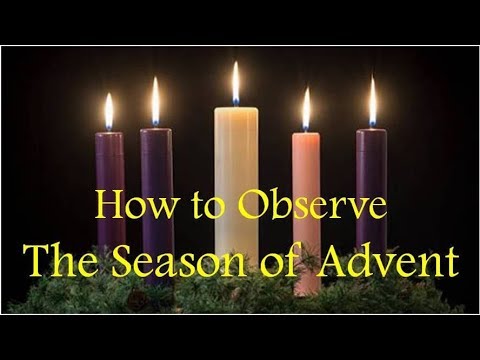
Advent, Repentance, and the Prayer Book’s Way of Preparation: It's More than a Wreath

Advent is a season of beauty, expectation, and penitence.

Advent is frequently a misunderstood season today, and thus often not fully experienced.  It is typically reduced to wreaths, candles, and a countdown to Christmas (or, even a sort of prolonged "pre-function" to Christmas) involving chocolate-filled calendars. It is far more than that. Advent is a complex season with multiple dimensions and a strong call to engage in repentance -- yes, repentance.

This ispenitential season – despite the occasional cavil from more recent liturgical experts – but not in the same way as Lent. Advent’s preparation for the Feast of the Nativity of Christ is marked by a high degree of eschatological expectation, for Advent is really a preparation for two “comings” of Christ: his “coming amongst us in great humility” as the Collect for the First Sunday of Advent says and which we celebrate at Christmas, and “when he comes again in majesty to judge both the quick and the dead” at the Last Judgement. Both require serious and considered preparation. This is why St. John the Baptist and his urgent call to prepare for the coming of the Lord features so strongly in the readings, prayers, and hymns for these weeks.


Because true Christian belief and practice about the Last Judgement is founded upon hope and joy (rather than fear and anxiety), any sense of trepidation about the “Last Things” is a sign that we have spiritual work to do – and who among us is free from this ongoing work “now in the time of this mortal life” as the great Advent Collect puts it? Advent, with its focus on expectation and preparation, naturally serves as a time to consider what needs repentance and reconciliation in our life. 


This is all very well to say, but how do we respond?  The Prayer Book provides some clear direction.


First, there is the matter of examining our conscience.  By engaging in this practice, we are led to see what the Holy Spirit is prompting us to address at this juncture in life.  Tools for this work abound in the Book of Common Prayer:

·      The Ten Commandments (from the Penitential Order in the Holy Eucharist)

·      The Summary of the Law (from the same place)

·      The five baptismal promises found in the Baptismal Covenant (in the Baptismal liturgy)

·      The Litany of Penitence (from the Ash Wednesday liturgy)

·      The Great Litany

·      The Catechism

·      The Psalms & Collects


There are, of course, many other tools for examining our conscience (reading from the Sermon on the Mount is one, or one might use one of the traditional forms found in such non-BCP resources as The St. Augustine’s Prayer Book).


Once we have spent time in careful consideration about what is at issue, it then follows that we confess to God our sins and receive assurance of God’s pardon.  In the Anglican and catholic tradition of the faith, there are three such forms: Private Confession, General Confession, and Sacramental (auricular) Confession.


Private Confession is what we do on a daily basis in our own private prayers. It is often how we approach the Confession in Morning / Evening Prayer or the bedtime service of Compline when said alone (though, one must always remember, these services are always liturgical services and thus part of the whole Church's offering, even if said alone).  


This is our regular application of what Jesus teaches in the Lord’s Prayer: “Forgive us our trespasses as we forgive those who trespass against us.”  Confessing our sins to God should be a natural part of life – not as an act of shame or scrupulosity, but openness and candor with our God. It may be done at any time and it is indeed good to become able to confess quickly, just as the Lord's Prayer suggests. It will help up learn to forgive others quickly, as well.


General Confession takes place in community, in the context of Morning or Evening Prayer when gathered in church, or at the Holy Eucharist as we prepare to receive the Holy Mysteries of Christ.  It reminds us that sin is never a purely private matter (a “victimless crime”), but always impairs our relationships with both God and neighbor.  


This form of confession is closer to how the earliest Christians confessed their sins to one another, and thus connects us to the ancient Church’s pattern of acknowledging sin as a body.  It is also an important (essential) part of participating in public worship and particularly in receiving the Holy Sacrament.  One other point: General Confession is followed by the priest/bishop pronouncing an assurance of pardon, making clear that our confession and repentance is predicated on God’s mercy eternally offered in Christ's death upon the cross; the ordained minister is not a magical pipeline of that forgiveness: it is a declaration of that eternal al forgiveness over God’s penitent people assembled for worship.


Finally, there is Sacramental or Auricular Confession.  Here, a penitent confesses to God and the Church in a private manner – with only a priest present.  This form of confession is especially appropriate for sins of a serious nature, for old sins which have long continued to plague one’s conscience, for relapses into past patterns, at the end of life or when preparing for confirmation, marriage, ordination, or other major changes in our life, or when God’s forgiveness seems far away.  


Sacramental Confession is a part of the Church’s healing ministry and is directly connected to our baptism.  It is essentially spiritual medicine and may be received either at posted times in the church’s schedule, or by special arrangement with the priest.


Advent’s brevity is actually one of its best features: it makes clear that the time for setting our house in order is limited, and that God awaits our cooperation for our healing and renewal.  The joyful expectation which marks the season is also a summons to enter into this work with alacrity and zest: God desires our freedom and has come amongst us to secure it.  It is now time for us to respond by discernment and repentance so that we may enter more fully into the joy set before us – a joy begun at Christ’s nativity and culminating in the final “setting to rights” of all things in the love and truth of Christ’s return.


Let us all make this Advent season now begun a profitable season of spiritual renewal and restoration, “now in the time of this mortal life.”  By entering into a careful consideration of our conscience and appropriate repentance, followed by confession in the full assurance of God’s loving pardon, we may come to Christmas with a greater joy and a less burdened heart, ready to celebrate and live with our eyes firmly fixed on that day when, by God’s grace, “we may rise to the life immortal,” already begun in our life in Christ now.


Almighty God, give us grace that we may cast away the

works of darkness, and put upon us the armor of light, now

in the time of this mortal life in which thy Son Jesus Christ

came to visit us in great humility; that in the last day, when

he shall come again in his glorious majesty to judge both the

quick and the dead, we may rise to the life immortal; through

him who liveth and reigneth with thee and the Holy Ghost,

one God, now and for ever.  Amen.


Thursday, August 29, 2019

A Self Examination at Day’s End


Below is an adaptation of an old self-examination found in an Anglican book of devotions. Such tools for daily reflection, when used judiciously, can help us become more conscious of how we are living as Christians in the world.

The traditional way to use a self-examination is to take time in silence prior to our evening prayers and recollect the day and its various events, surveying the day through the self-examination, point-by-point. Some people find it helpful to keep a journal of their reflections; some find it beneficial to share the fruit of such self-examination with a spiritual director or a trusted spiritual guide; others prefer to do all of this process mentally and on their own. 

This need not be an elaborate or exhaustive practice. It should definitely not be scrupulous or perfectionistic. Its purpose is not punitive; rather, the goal is to raise consciousness and increase the intentionality of our daily Christian discipleship. This leads not to sullen frustration but joyful reliance on God.

After having spent time in reflection this way, it is customary to name before God those sins we know we have committed, followed by the confession of sin and the assurance of pardon found in the Daily Office. 

A regular practice of spiritual self-examination together with daily praise and adoration of God and thanksgivings for blessings received, will form a solid basis for progress in spiritual life. 

A Daily Self-Examination 

- How have I spent this day?

- Have I striven to remember God’s presence, and to do all things as in the sight of, and offered to, God?

- What has been the character of my prayer through the day?

- How have my actions been performed, and what has been the nature of my contact with others?

- How have I been faithful to God today?

- When did I call upon God for wisdom or strength?

- What time was wasted or ill-used?

- What duties have I neglected towards God, my neighbor, or myself?

- Of what sins—in thought, word, and deed; done or left undone—am I conscious?

- Have I fallen today into my besetting sin, and if so, why and under what circumstances?

Wednesday, January 16, 2019

A self-examination for use before ordinary confessions


What follows is an example of a tool for examination of conscience. Such tools can be elaborate or simple. I hope to review a number of self-examinations through this blog in the coming weeks as we prepare for what George Herbert calls the “Dear Feast of Lent.”

This particular self-examination is meant for clergy, though it doesn’t take much adaptation to make it quite useful for laypersons. It takes the form of eight brief sections with a few specific considerations in each. Some of them are expected (prayer life, for example), but others are rather more surprising (how seriously am I repelling the first suggestions of sin in my daily life?). 

Noting our responses to each and then taking time to journal or reflect on what these questions elicit can form an excellent preparation for a private confession as part of Evening Prayer (say), or (as in this case) a sacramental confession with a priest.

If we want a healthier Church with healthier witness to Christ, it is essential that we provide and encourage the use of sound tools for ascetic training. The current state of affairs suggests these ancient practices should be renewed in our day.

I. My daily prayers? Meditation? Preparation and thanksgiving when celebrating? Daily Office? Spiritual reading? Daily examination of conscience? First and last thoughts of the day?

II. My rule of confession? Preparation for confession? Contrition? Amendment of life?

III. Profit from my communions? Remembrance of them during the day and week?

IV. Administration of sacraments: Punctual? With care? Edifying?

V. Sermons prayerfully prepared? Focused on the texts? Misuse of my own personal struggles through the pulpit? Parish visiting? Care of children? The sick? 

VI. Temperance: In food? In drink? Charity? Envy? Detraction? Sharpness in rebuke? Chastity? Custody of thought? Repelling first suggestions and temptations? Desire? Looks? Words? Deeds?

VII. Have I kept my rule of life?

VIII. What about my besetting sin?

[Adapted from The Priest’s Book of Private Devotion, 1960 edition.]

Friday, January 26, 2018

St. Paultide Reflections – Hope for imperfect people


I am currently making my way through the little book of talks collected under the title The Road to Eternal Life by Michael Casey, OSB. I have found it very helpful not only as a commentary on the Prologue to the Rule of St. Benedict, but as a distillation of much of the best of Western catholic Christian thought and practice.

With the Feast of the Conversion of St. Paul yesterday, we have entered into a short period in the calendar focused on this Apostle, his character and story, ministry, and some of the important figures arising from that ministry (including the Patron Saint of the parish I serve).

In a delightful example of synchronicity, my daily readings from Casey’s book have recently drawn much of their insight from the writings of the Blessed Apostle, and I wanted to share with those who might read this blog a few passages I have found very useful.

“It is by God’s grace that I am what I am” – warts and all. When I survey the landscape of my giftedness, it is not hard to praise God as its origin. There is, however, another side to my life that I hope will never intrude into public awareness. This is the shameful history of my selfishness and hardheartedness. For this I alone seem responsible. Indeed, this appears to be what Saint Benedict is saying in the fourth chapter of his Rule: “If he sees anything good in himself, let him refer it to God and not to himself. But let him know that the evil is always from himself and take responsibility for it.” (RB 4.42-43)

I do not want to appear to be ascribing to God the ugliness that is entirely my own creation. What I am saying is that the aspects of my life that are displeasing to me are not outside God’s plan; they are designed to bring me to a fuller realization of the unconditional character of God’s love. If I were all sunshine and light I could easily believe that God loves me because of my inherent goodness and that, in some way, I have made myself eminently worthy of that love. That seems to be a harmless enough delusion, but it is not. What do you think will happen when eventually I fall into some action that even I cannot deny, excuse, or rationalize? The logical conclusion will be that because of my misconduct God no longer loves me. My shame will quickly lead me to despair, as though God could be surprised and disgusted by the way human beings act.

Here’s what the fourteenth-century English mystic Julian of Norwich has to say about this situation:

For, in truth, we shall see in heaven for all eternity that though we have sinned grievously in this life, we were never hurt in God’s love, nor were we ever of less value in God’s sight. This falling is a test by which we shall have a high and marvelous knowing of love in God forever. That love [of God] is hard and marvelous that cannot and will not be broken for our trespasses…In love mercy allows us to fail somewhat, and in failing we fall, and in falling we die…Our failing is full of fear; our falling is marked by sin; our dying is sorrowful. Yet in all this the sweet eye of pity never departs from us and the working of mercy never ceases. (Revelation 14, chaps. 61, 48)

It is true that it is by God’s grace that we are what we are and by God’s grace we have been preserved from countless calamities of our own making. Even though we fall short of our own hopes and expectations, it is by God’s grace that we are what we are. God has a plan for us, of which we have only the sketchiest knowledge. Let us allow God to get on with the work and not delay its outcome either by taking credit for what meets with our approval or by becoming downcast when we are plunged into the mystery of our own resistance. “It is by God’s grace that I am what I am.” Whatever I have, I have received from God, and whatever I have become, it is part of the mystery of Providence. As always, the bottom line is this: I can never be beyond the pale of divine mercy.

As I reflect on this passage, a number of things stand out as very important and useful in my life as a disciple and in my work as a pastor of souls.

The first is found in the sentence: “Let us allow God to get on with the work and not delay its outcome either by taking credit for what meets with our approval for be becoming downcast when we are plunged into the mystery of our own resistance.”

In my own life, I have often been intensely frustrated—and embarrassed—by the degree to which I have resisted God’s promptings and direction. Invariably, when I finally let go of the resistance to what God is giving me grace to embrace (this is the moment of compunction or penthos, followed by repentance), real growth follows.

Over the years, I have come to see my resistance as an apparently necessary part of the work of being a disciple. Instead of being disgusted or even terribly embarrassed about this, I am gradually coming to accept that part of my humanness is being a thickie when it comes to learning the Gospel way of life.

In doing so, I have found that the resistance actually declines. Part of the resistance to God, it seems, is simple pride and stubbornness. When one accepts the limitations of the self and our actual need to fail as part of the process of believing and growing in belief, this self-acceptance leads to quicker repentance and greater assurance of God’s ongoing love for me…in spite of my sins.

The quote from Bl. Julian of Norwich is another part of this section of Casey’s book I find helpful. That the sweet eye of pity never departs from us and the working of mercy never ceases is an important truth for me to accept as I learn the implications of what we are taught in 1 John 4:8 (“God is love”). If God is indeed love, then all elements of a human-style transactionalism or quid-pro-quo relationship must be cast out.

St. Paul experienced perhaps the most intense form of realization that one’s faith has been mistaken. The feast we celebrate on January 25 is as much about his failing on his own as it is about God’s success in his life. His failing, then his falling, and finally his dying-and-rising to new life in Christ, is a clear exposition of what all who follow Jesus must undergo, each in his or her own way.

This fact never departed the Blessed Apostle. His writings frequently betray self-knowledge of his resistance—in the past and as an ongoing reality in his life. But, “It is by God’s grace that I am what I am” remains true for him—and us—at each step of the journey. This form of self-acceptance does not lead to complacency; indeed, it is inimical to complacency. Rather, it is a growing awareness of what God’s love for us really means, and how that love brings forth from us more and more desire to let salvation be accomplished in us, rather than resist it.

It is not that God creates our sinfulness or our brokenness—not at all. Yet, God’s work in our life goes beyond the day-to-day: he knows our potential self already, and the work of salvation we experience in moments of growth and in moments of resistance to that growth partakes of an ongoing relationship, a communion that is itself an expression of our created nature and God’s revealed will for his creatures.  In this sense, our resistance—like St. Paul’s—becomes part of our own story of God’s victory rather than merely our folly. Even our resistance, you see, must be given over as an intentional offering to God.


When we learn to “get over ourselves” and allow God to love us through the good and the bad, we join St. Paul in being able to say: “It is by God’s grace that I am what I am,” and say so in hope as we make our way towards that perfection which only communion with our knowing-and-loving Triune God makes possible. And that is very good news, indeed for as-yet imperfect disciples like me.

Friday, October 20, 2017

Praying Christ's Passion


Below is an excellent example of a classic prayer updated and adapted for modern usage. This litany allows for those praying it time to reflect on the events of Christ's Passion so as to foster loving gratitude and a deeper understanding of both Our Lord's humanity and his complete identification with us in our need.

This litany also challenges us to see where we fall short of honoring Christ in his Passion in our thoughts, words, and deeds -- helping to give our Friday devotion more substance and connection with the rest of our lives.

Use of this litany is one way for us to honor the Church's teaching that each Friday is a "little Good Friday," as each Sunday is a "little Easter."

+    +    +


A Litany of the Passion (contemporary language form)

This litany may be used as a private devotion on Fridays through the year (especially during mid-day), during Lent as part of a Lenten rule of prayer, as devotions on Good Friday or before/after the Stations of the Cross.

God the Father, maker of heaven and earth,
Have mercy on us.
God the Son, Redeemer of the world,
Have mercy on us.
God the Holy Spirit, sanctifier of the faithful,
Have mercy on us.
Holy Trinity, One God,
Have mercy on us.

Silence follows each line until the versicle and response.

Jesus, gathering your disciples at the table:
Jesus, washing their feet in humility:
Jesus, offering yourself in bread and wine:
Jesus, going into the garden to pray:
Jesus, whose disciples slept while you grieved:
Jesus, in fear and from a troubled soul, still seeking the Father’s will:
Jesus, whom Judas betrayed with a kiss:

V. We adore you, O Christ, and we bless you,
R. Because by your holy cross you have redeemed the world.

Jesus, standing before Annas and Caiaphas:
Jesus, spit upon, blindfolded, and struck:
Jesus, against whom false accusations were made:
Jesus, denied three times by Peter:
Jesus, taken before Pilate:
Jesus, rejected for a murderer:
Jesus, exhibited before the crowds:
Jesus, condemned by Pilate:

V. We adore you, O Christ, and we bless you,
R. Because by your holy cross you have redeemed the world.

Jesus, crowned with thorns:
Jesus, mocked by soldiers:
Jesus, sent out carrying the cross:
Jesus, whose cross Simon was made to carry:
Jesus, whom the women mourned:

V. We adore you, O Christ, and we bless you,
R. Because by your holy cross you have redeemed the world.

Jesus, nailed to the cross:
Jesus, lifted high upon the cross:
Jesus, praying forgiveness for us all:
Jesus, giving your mother and beloved disciple to each other:
Jesus, granting paradise to the penitent thief:
Jesus, crying out in abandonment:
Jesus, from whose side flowed water and blood:

V. We adore you, O Christ, and we bless you,
R. Because by your holy cross you have redeemed the world.

Jesus, taken down from the cross:
Jesus, wrapped in a shroud:
Jesus, buried in a borrowed tomb:

V. We adore you, O Christ, and we bless you,
R. Because by your holy cross you have redeemed the world.

From all evil,
Good Lord, deliver us.
From unbelief and hardness of heart,
Good Lord, deliver us.
From any denial of you,
Good Lord, deliver us.
From sloth and sleep when you call us to watch,
Good Lord, deliver us.
From all false judgments and untrue accusations,
Good Lord, deliver us.
From acts of cowardice and expediency,
Good Lord, deliver us.
From words that mock and scorn,
Good Lord, deliver us.
From cruelty and disregard of injustice,
Good Lord, deliver us.
From all refusal to know our own sins,
Good Lord, deliver us.
From all fear to stand by when another suffers,
Good Lord, deliver us.

Hear our prayer, O Lord, and grand that we may die daily to sin and live in righteousness,
Hear our prayer.
That we may take up our cross daily and follow you,
Hear our prayer.
That we may never deny you,
Hear our prayer.
That we may never falsely accuse or violently attack anyone,
Hear our prayer.
That moved to sorrow by your sufferings, we may work for the relief of others,
Hear our prayer.
That we may receive with gratitude the promise of forgiveness and reconciliation,
Hear our prayer.
That having followed the way of the cross in this life, we may come to the joys of your eternal kingdom,
Hear our prayer.

Lord, have mercy.
Christ, have mercy.
Lord, have mercy.

Lord, remember us when you come into your kingdom, and teach us to pray:

Our Father…deliver us from evil. Amen.

By his cross and passion, + may our Lord Jesus Christ bring us to the joys of paradise. Amen.


- From The St. Augustine’s Prayer Book,
Forward Movement Publications, 2014

Friday, February 12, 2016

The Healing Power of Confession

The meaning and use of sacramental confession in Western Christianity has long been undermined by a pervasive legalism that both distorts the origin of this rite and undermines its proper, regular (and joyous) use today.

The Reconciliation of a Penitent (a.k.a. "confession") is based on Christ's commission to the Apostles to "bind and loose" sins on earth, thus continuing in the Church Our Lord's work of reconciling God and humanity through declaring forgiveness and speaking truthfully about the nature and character of sin.  As part of their ordination, bishops and priests are given the authority to declare God's forgiveness.  This is exercised in Liturgy though the absolution following general confession, as well as at sacramental confession

Originally, the Church knew nothing of the practice of making a confession alone to a priest. In the early period of Christianity (and in some traditions still), confession was made out loud to the entire assembly. This demonstrates a deep and courageous understanding of the Church as Christ's redemptive Body at work in the world, and as a body of people all in need of forgiveness, all desiring to be reconciled with each other and to pray for each other's reconciliation. In the Eastern Orthodox tradition, this ancient practice is echoed in the still-current way of making a confession privately to a priest during the liturgy, off to the side of the chancel area, but still in a semi-public location.

The significance of confession for ancient Christianity was deeply connected to baptism. When one became a part of Christ's body through birth in the font and receiving the Holy Spirit in anointing, the Christian was no longer an alienated individual, but a person in the deepest sense: one who was now in a restored relationship with God the Holy Trinity, the Creation, the  neighbor, and the true self in Christ. Sin after baptism damages the health of this "spiritual organism," requiring healing to repair the damage done to this loving communion. Thus, confession's true meaning is connected to the healing ministry of Christ seen in the Gospels and lived out in the Church's continual offering of pastoral care, intercession, and reconciliation.

In the Western part of the Church, confession of sins was gradually removed to the privacy of a meeting between the penitent and the confessor at a time outside of the public conduct of the Liturgy, though often in the church building itself. This was accompanied by a change in expressed character. Now confession came to have a judicial character, based on the image of the Last Judgment in the Gospels and the Book of Revelation. Slowly and at times imperceptibly, the priest moved from being a physician of the soul to a deputy judge. The entire nature of confession became a type of transaction: I commit this infraction against the Church's "code of legal conduct" and must pay the prescribed penalty through a penance imposed by a spiritual bureaucrat. Once this was done, one could feel "justified" and then make a "worthy" communion or (more importantly) be "properly" prepared to die and meet the criteria for escaping damnation. All this undermined the deep connection with baptism or the profound personal encounter between one in need of healing and the Church's mission of healing.

By the time of the Reformation, this transition in the nature of confession had become so complete that many saw it not as a way back to God through repentance and spiritual healing, but as an obstacle to God.  Many reformers sought to bring confession back to its origins (confession to the entire assembly, or, more commonly, private confession within the assembly gathered for worship). Private sacramental confession was largely stripped from the life of the Reformed tradition in Christianity.

But, in the Anglican tradition, a curious thing occurred. While the stand-alone rite of sacramental confession was removed and largely replaced with a general confession in most services, it did survive in one particular context: the service of healing (then called "The Visitation of the Sick"). Indeed, in this service, a great deal of effort was put into a thorough examination of one's faith and practice. Everything from a recommitment to basic baptismal faith (the Apostles' Creed was reaffirmed), to forgiveness of those with whom the sick person was at enmity, to the right use of one's possessions and wealth (with emphasis on giving to the poor and needy) was covered in detail. 

Thus, in Anglicanism the long process of returning confession to its origins as baptismal healing--not judicial retribution--had begun.

While this service was intended for use in cases of serious sickness (remembering that, in times past, many sicknesses fell into this category), some clergy used it more liberally, seeing it as an excellent means of periodic examination of conscience for members of the Church, especially in Lent. Indeed, there exist records of some Anglican bishops growing concerned that certain priests were using this rite rather too liberally...perhaps dangerously akin to the Roman Catholic practice of confession! Oddly enough, the "official" emphasis in Anglicanism, for all of its reformed intent, continued the medieval coupling of confession and absolution before death so that the individual Christian could face God's judgment with hope and a clear conscience.

In the nineteenth century, straightforward sacramental confession reappeared in the Anglican tradition for the first time since the Reformation. Though not expressly permitted by the Prayer Book, its practice gradually blossomed in many parishes, monastic communities, and other settings. This meant that confession was no longer directly linked to sickness and death—a good thing for the wider pastoral ministry of the Church. But, it also meant that the model most at hand used at the time of this renewal was the juridical view of confession then current in nineteenth century Roman Catholicism.

This colored the view of sacramental confession in Anglicanism—partly because of anti-Roman Catholic bigotry, but also out of a deep concern that the obstructive mechanism of medieval “Penance” would undermine the "blessed liberty wherewith Christ has made us free" so valued by Anglicans. While Roman Catholicism had produced many clergy with a distinctly deeper, broader, and more holistic view of confession (e.g. the Curé d'Ars), the prevailing view remained transactional, with the priest very much understood as judge rather than witness, representative of the Body, or spiritual physician.

As the twentieth century wore on the careful study of the Early Church and the confession practices of the Eastern Orthodox churches began to have an impact on Roman Catholic and Anglican views of sacramental confession. Eventually, the Second Vatican Council and various Anglican synods, councils, and conventions began to reform the confession rites so that the focus moved from transaction or judgment to healing and reconciliation with baptismal identity. When the Episcopal Church put forth its new Book of Common Prayer in 1976/79, it added back (for the first time since the Reformation) a separate liturgy of sacramental confession…now called “The Reconciliation of a Penitent.”

When it did so, it acknowledged the two currents that remain in the Anglican tradition with regard to this sacramental rite by having two different forms for Reconciliation. While sacramentally the same, they differ in tone and spiritual emphasis.

The first form is very much in the style of classic Western confessional services: the penitent asks for a blessing to make a true and worthy confession and receives this blessing from the confessor. The confession is made (being clear that it is to God and “the whole Church” through the ministry of the confessor), opportunity for counsel, direction, and comfort provided for, and then absolution given (with two optional forms of absolution provided…one being the classic “I absolve you of your sins” in the name of Christ, the other emphasizing Christ’s forgiveness first, through the ministry of the confessor). Short and to-the-point but also powerful and clear: sins are forgiven by God so that we may return to fullness of life in Christ in this world and the next.

The second form is longer, more deeply connected to the rest of the Sacraments, more Scripturally-focussed, and more clearly grounded in the concept of baptismal reconciliation and spiritual healing. It begins with the confessor and penitent both praying a portion of Psalm 51 (the great psalm of penitence), and saying together the ancient hymn of praise called the “Trisagion,” or “Thrice holy hymn.” This establishes the truth that confession is a liturgy of the Church, not a private “spiritual transaction,” and that confessor and the penitent are both members of the Laos or People of God—not members of two different “castes” of Christians, one judging the other.

The second form continues with the penitent asking for and receiving a blessing to make a true and honest confession, followed by a series of passages from Holy Scripture long used by Anglicans to give assurance of God’s desire for our reconciliation and redemption. Thus assured and encouraged by the confessor (who is a fellow Christian with a special calling and grace to minister God’s forgiveness), the penitent proceeds to offer a beautiful prayer recounting God’s gifts of creation, redemption, and baptism—and, the fact that we have misused these gifts through sin, using the language of Christ’s parable of the Prodigal about “wondering in a land that is waste.”

The prayer may begin more on the general level, but moves to the specific when the penitent adds his or her own personal sins to this prayer. Following these specific sins, the prayer recognizes that we are confessing not only the sins we can remember, but all of the involuntary sins, or those we have forgotten, and so opening our entire selves to God, holding nothing back in this encounter and fully expecting total forgiveness—such is the radical nature of this sacramental experience. The prayer comes to a close with a plea for restoration to the full life of the Church—full realization of the personal life of faith, where relationship with God, neighbor, and the true self-in-God may occur.

The confessor then is given opportunity to provide counsel or guidance as part of this ministry of healing. This is often where the Anglican emphasis on pastoral care, fitted to the individual, is found.

The second form of Reconciliation then proceeds to ask two important questions, both of which  relate to the baptismal liturgy and point directly to the restoration of the penitent to baptismal grace and the full life of the Church: “Will you turn again to Christ as your Lord?” and “Do you, then, forgive those who have sinned against you?” Once more, we see here the truth of sacramental confession as something far deeper than mere satisfaction of an exterior code or set of rules: this is about restoration to the active and healed life of the organism of the Church, the Body of Christ and all its members. This is a dynamic sacramentality.

Only now, with a full reaffirmation by the penitent of a desire for communion with “that life which alone is Life,” and thus refuting the deforming and false logic of sin and its spurious promise of salvation through autonomy, does the confessor pronounce Christ’s absolution and restoration to "the perfect peace of the Church.” That which was put out of joint, cut off, alienated, has now been re-joined fully to the Body which is truly alive, resurrected, and partaker of the Divine Nature.

Having gained this moment of spiritual revivification, the confessor recalls once more the story of the Prodigal, but now with its ringing affirmation of restoration through this triumphal “welcome home” from the Father:
Now there is rejoicing in heaven; for you were lost, and are found; you were dead, and are now alive in Christ Jesus our Lord.  Go in peace.  The Lord has put away all your sins.
To which the penitent-now-restored gives the response provided at the end of the Eucharist—to the fullness of which he or she is now brought back: “Thanks be to God.” All has been healed and all sin forgiven; the long-awaited Lost One has returned, and the all the Church throughout the ages rejoices before God the Holy Trinity.

*  *  *

And so, this long reflection on the history of sacramental confession brings us back to where we began: with Christ’s commission to the Church to continue his work of reconciliation-- confronting sin amongst his members not with judicial legalism but with a profound thirst for our return, our restoration to the truth of personal communion given at baptism.

What had become distorted through history and a cooling of human hearts has been set right by God’s grace in the Church so that a means of healing for wounds and sins perhaps not visible but nonetheless very real might be made available to the Faithful. Now it is time for more Episcopal parishes to make sacramental confession regularly available to their people, that this gift might be once more part of the common (shared) life of the community--not an adjunct or "extra" sought out by only a few and really understood by even fewer.

It is this hopeful, healing, and joyful understanding of sacramental confession that is found in the Episcopal Church's Book of Common Prayer, and is offered regularly at St. Timothy’s throughout the year—and especially in the holy season of Lent.