Monday, August 29, 2022

The Martyrdom of St. John the Baptist: Telling the Truth


August 29 is the commemoration of the beheading of St. John the Baptist. It is a solemn day, with a story well-attested in the Holy Scriptures, long honored by the Church (though only recently recognized by the Episcopal Church, for some reason).

The Holy Forerunner's death is deeply connected to the story of his nativity (June 24) and the his father Zechariah's prophesy in Luke. It is also directly connected to Christ's nativity and our Savior's embodiment of Truth. We encounter the Baptist's significance and ministry each time we pray the Benedictus Dominus Deus at Morning Prayer -- which, depending on which canticle one uses, could be just about each morning.

Throughout the year, John plays a central part in the story of salvation. In Advent he heralds the coming Messiah by calling all to repent and prepare. His baptism of Christ is central to the entire logic and purpose of Epiphanytide. His boldness and proclamation of repentance is recalled again in Lent. His promise that the One he heralds will bring the Holy Spirit with fire binds Advent to Pentecost.

This omnipresence in the Church year mirror's John’s centrality to the Gospel narrative, from the beginning of Mark through the opening of the Book of Acts. His fierce insistence on divine truth and faithfulness in the face of earthly power is a foundation on which Jesus built and upon which the Christian Church’s ministry of prophetic witness flourishes. Because of his utter fidelity to God’s call, he died a martyr’s death – prefiguring Christ's death at the hands of unjust leaders, as well as the countless other who follow in his footsteps to this day.  Indeed, our day has seen the making of a vast number of martyrs, many beheaded in much the same manner as the Blessed Forerunner -- hidden away in dungeon and "secure locations."

John's witness with regard to the interaction of faith and political power speaks to us in especially potent ways today. His uncompromising commitment to telling the truth in the face of overwhelming secular power sets the standard for authentic Christian life -- and shows how weak and hypocritical many in the Church (lay and ordained, then and now) are when dealing with "the powers that be" when the Church becomes enmeshed with the "power of the sword."

When John said to Herod “you cannot have her” with regard to Herod’s liaison with Herodias, the wife of his brother Herod Philip, it was too much. John was just possibly endurable when he was taking on the religious leaders, but here he was crossing the line into the lane where the traffic is fast and unmerciful. Herodias, tired of Herod’s anxious shilly-shallying about John, wanted this meddling holy man dead and found a way to achieve it. Using the occasion of a drunken birthday party, she slyly planted her daughter as dancing bait for Herod’s inebriate lust. Wildly making public promises of largesse, Herod was in her debt…and Herodias's daughter took him down like an experienced hustler takes down a green rube just off the bus from Nowheresville. In the time it took for the music to stop, Herod was in over his head, and John was without his. The message was clear: Don’t get in the way of powerful people when reputation, politics, and personal cred are on the line. This is ever the case.

The portrait of arrogance, privilege, decadence, and drunkenness emerging here is remarkably appropriate to current events. With so many Christians being willing to go along with Herod's "might-makes-right" reasoning, and with nearly idolatrous levels of support given to politicians very much Herod's kin in terms of behavior by many "Christian" leaders as well as the rank-and-file, one could well imagine John the Baptist's head being lopped off with their quiet nod today. He would have to go, you see: he made the base angry.

The teaching potential of this holy day is great. It shows that to confront evil, we need endurance. Sometimes, it seems that evil actually wins; but its victory—like Herodias’s -- is only apparent. In reality, God’s power and truth is finally completely victorious. It survives continual assault as a vision and a desire. God's vision will forever keep popping up, no matter how many are "cancelled" by silencing or decollation. 

What is needed is an ongoing commitment to Gospel justice, even in the face of evil’s awful array of violence, lies, distortion, and corruption. To the last drop, the last moment, the last sentence, St. John the Baptist witnessed to such a commitment. This is why we keep this day.

This day reminds us that by following Jesus Christ as Lord (whom John heralded), we share in this revolutionary ministry of truth-telling. 

If we in the ordinary congregations of the Church take this vocation seriously, maybe even the so-called "leaders" of a heavily-compromised American Christianity follow the Holy Truth-Teller until the day when all lies are exposed and all elites humbled. Then the tragedy of this day will be crowned with true glory. As it is, we journey on in hope and faithfulness.


A Collect for the Martyrdom of St. John the Baptist

God our Father, you called John the Baptist to be the herald of your Son's birth and death. As he gave his life in witness to truth and justice, so may we strive to profess our faith in your Gospel. Grant this through our Lord Jesus Christ, your Son, who lives and reigns with you and the Holy Spirit, one God, for ever and ever. Amen.

Wednesday, February 2, 2022

A Light to Enlighten the Nations: The Feast of the Presentation


On the Feast of the Presentation


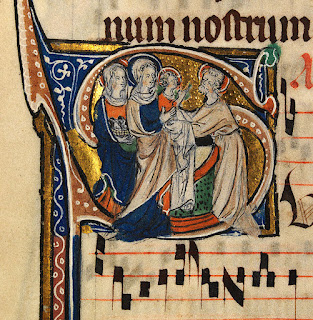
Today we rejoice that Christ has come into the Temple to be presented, in accordance with the Law of Moses, to His Father. The story is found in Luke 2: 22-40.


This is a day of extraordinary beauty. In it is fulfilled the yearning of an entire people…though secretly, quietly, gently. The ancient Temple has its true purpose revealed and completed: the presence of God in this Holy Place is now complete, and the hostility between humanity and God is being overcome by God's own initiative


Mary and Joseph witness in awe and wonder the meaning of this moment, treasuring it in their hearts as will all future disciples of Christ. A prophesy of struggle and suffering for Mary is pronounced, something true for her in a unique way, but also a fact for anyone who follows Christ and the Gospel Way authentically.


Yet, there is more. Aged Simeon holds the child who is his Messiah in his own arms, bringing age, infancy, and eternity together. Anna—another aged prophetess—so rejoices at the Messiah’s coming that all around her take note in her delight. It is a day marked by joy, a joy much like that of the Day of Resurrection which it prefigures.


Each person who confesses Christ is fundamentally alive in this joy. It is a mark of true discipleship. Young and old, insightful and simple, mystical and practical: we all share in the light of Christ’s presence. That presence transforms and fulfills us in ways we cannot comprehend or imagine. It reaches through us into the lives and needs of others. “The light has come into the world, and the darkness has not overcome it.”


For centuries, it has been the custom of those celebrating this feast to light small lamps or candles, recalling the light of Christ now come into the world—and especially the Holy Spirit given to us each as members of Christ's body. At Holy Baptism, a candle is presented to the newly-baptized (or a sponsor) to remind all present that this light is conferred and must be cherished and borne into the world.


Do we consciously bear Christ’s Light? Do we honor it? Do we see it as the one true gift—quite apart from our opinions, agendas, experiences, and goals—we have to give? Let us pray that this is so for us. To substitute something else for this light is to turn our back on the Savior, and to close the door on the mystery and power of the events celebrated on this beautiful day.


Rejoice with the Blessed Virgin, with St. Joseph, with aged Anna and Simeon on this day…and share the light given to you long after the candle you bear is extinguished!


A reading from a sermon by Sophronius, Patriarch of Jerusalem (7th Century)


Our lighted candles are a sign of the divine splendor of the one who comes to expel the dark shadows of evil and to make the whole universe radiant with the brilliance of his eternal light. Our candles also show how bright our souls should be when we go to meet Christ.


The Mother of God, the most pure Virgin, carried the true light in her arms and brought him to those who lay in darkness. We too should carry a light for all to see and reflect the radiance of the true light as we hasten to meet him.


The light has come and has shone upon a world enveloped in shadows; the Dayspring from on high has visited us and given light to those who lived in darkness. This, then, is our feast, and we join in procession with lighted candles to reveal the light that has shone upon us and the glory that is yet to come to us through him. So let us hasten all together to meet our God.


The true light has come, the light that enlightens every man who is born into this world. Let all of us, my brethren, be enlightened and made radiant by this light. Let all of us share in its splendor, and be so filled with it that no one remains in the darkness. Let us be shining ourselves as we go together to meet and to receive with the aged Simeon the light whose brilliance is eternal. Rejoicing with Simeon, let us sing a hymn of thanksgiving to God, the Father of the light, who sent the true light to dispel the darkness and to give us all a share in his splendor.


Through Simeon’s eyes we too have seen the salvation of God which he prepared for all the nations and revealed as the glory of the new Israel, which is ourselves. As Simeon was released from the bonds of this life when he had seen Christ, so we too were at once freed from our old state of sinfulness.


By faith we too embraced Christ, the salvation of God the Father, as he came to us from Bethlehem. Gentiles before, we have now become the people of God. Our eyes have seen God incarnate, and because we have seen him present among us and have mentally received him into our arms, we are called the new Israel. Never shall we forget this presence; every year we keep a feast in his honor.


Collect for the Feast of the Presentation


Almighty and everliving God, we humbly pray that, as your only-begotten Son was this day presented in the temple, so we may be presented to you with pure and clean hearts by Jesus Christ our Lord; who lives and reigns with you and the Holy Spirit, one God, now and for ever. Amen.

Wednesday, December 15, 2021

The Heart's Hidden Manger


The days are getting quite short now as we approach St. Thomas's Day and the Winter Solstice. Advent's sense of expectancy and quiet contemplation is building to its peak. Of all the seasons of the Church Year, this is perhaps the one with the most interior sensibility and I delight in this.

My own Advent Rule has been focussed on going into that quiet place with Christ and resting in him--finding my peace in his presence. Given all the swirling news and events around us this has been extremely valuable.

I often think about Mary and Joseph in these final days before Christmas--about their journey to Bethlehem and how they might have felt. Were they anxious? Did they wonder whether God would provide a safe road on the way and a warm bed for them when they arrived? As I make my way through this second pandemic Advent I want to join them and ask them about how to travel unfamiliar roads in faith.

Like many of you, I find this season both very beautiful and yet also difficult. The beauty is found in happy traditions, memories, and opportunities to see and serve Christ in others. The difficulty can arise in a sudden flash as I wonder whether I can manage all the responsibilities, or when I lament the loss of people, times, or places in the past.

When I take the time to rest in Christ, to go to the manger and gaze upon Jesus, I find there the acceptance, peace, and hope I need. These hearty gifts are remarkably portable; they can go with me on my own Bethlehem-bound journeys of the heart and mind at this season and beyond.

I look forward to coming to the manger at Christmas--not only the one we set up in church or at home, but the manger Christ has prepared for me in the heart. That spiritual manger secretly feeds my soul in what I lack. It is a place of holy encounter and encouragement made precious by the Blessed Virgin and St. Joseph her dear spouse, who placed the Christ-child in its hidden center, making the Infant King available to all who would turn aside from the road and rest there, day or night, always.

Brandon+


Tuesday, December 14, 2021

Christ the Victor


Here is a perfect expression of how the Early Church understood the mystery of salvation. Here, St. Cyril is commenting on St. Peter’s confession of Jesus as the Messiah and Christ’s response to this confession. Note how Cyril views the Cross and Resurrection as part of a process of salvation, and especially how the Paschal Mystery is an overthrowing of tyranny and a shared victory for us all rather than simply the payment of a debt owed to God. This “Christus Victor” understanding of salvation is what we proclaim in the Episcopal Church, leading to a deeper appreciation of God’s perfect love, which “casts out fear.” (1 John 4:18). This passage also makes clear that Christ’s teachings and the Paschal Mystery are a united reality—the former being completed by the latter. Finally, such an understanding of salvation makes clear our response to share the faith lovingly by way of response and action rather than remaining passive viewers or recipients.


When, however, the disciple had professed his faith, [Christ Jesus] charged them, it says, and commanded them to tell it to no one: “For the son of man,” he said, “is about to suffer many things, and be rejected, and killed, and the third day he shall rise again.” And yet how was it not rather the duty of disciples to proclaim him everywhere? For this was the very business of those appointed by him to the apostleship. But as the sacred Scripture says, “there is a time for everything.” There were things yet unfulfilled which must also be included in their preaching of him, such as were the cross, the passion, the death in the flesh, the resurrection from the dead, that great and truly glorious sign by which testimony is born of him that Emmanuel is truly God and by nature the Son of God the Father. For that he utterly abolished death, and he faced destruction, and spoiled hell, and overthrew the tyranny of the enemy, and took away the sin of the world, and opened the gates above to the dwellers upon earth, and united earth to heaven; these things proved him to be, as I said, in truth God. He commanded them, therefore, to guard the mystery by a seasonable silence until the whole plan of the dispensation should arrive at a suitable fulfillment. 

St. Cyril of Alexandria (c. 376 – 444), from Commentary on Luke, Homily 49.

Tuesday, November 30, 2021

St. Andrew: Christian life and an Ordination Anniversary


May Andrew, gentlest of the saintly company
   Inspire forgiveness for our grievous trespasses
That we, sore burdened by offences manifold 
   At his petition may obtain deliverance

(Verse from a hymn on St. Andrew’s Day)


Almighty God, who hast given such grace to thine Apostle Saint Andrew, that he counted the sharp and painful death of the cross to be an high honour and a great glory; grant us to take and esteem all troubles and adversities which shall come to us for thy sake, as things profitable for us toward the obtaining of everlasting life. Through Jesus Christ thy Son our Lord, Who liveth and reigneth with thee, in the unity of the Holy Ghost, ever one God, world without end. Amen.

(The Collect for the Feast of St. Andrew, Apostle, in the 1549 Book of Common Prayer)


November 30th is the Feast of St. Andrew “the first-called,” as recorded in the Gospel according to St. John. St. Andrew is my “ordination patron,” since I was ordained to the sacred priesthood on this day in 1993. In addition to seeking his prayers as a companion on the journey, I have thought a great deal about my patron over the years, learning more about his particular ministry and gifts—both from the Holy Scriptures and subsequent pious tradition.


Perhaps known best as St. Peter’s brother, the Fourth Gospel records Andrew as having first been a disciple of John the Baptist before becoming acquainted with Jesus and eventually following him (and in turn inviting his brother Peter to meet Jesus). From this we can tell he had keen spiritual thirst and insight. Andrew listened so deeply to John’s message that he knew John was not the Messiah, recognizing (as others couldn't, it appears) John’s mission of preparing the way for the Messiah.


I keep this aspect of St. Andrew’s witness in mind as I go about pastoral ministry. It is so easy to become wrapped up in personalities or issues that I can miss the true message. When younger, I sometimes became quite wedded to a particular figure or movement in the Church without recognizing how such passions and loyalties can take my attention and focus from following Christ and his gospel. It is surprisingly—and sadly—easy to substitute another “gospel” for the one our Lord taught. Andrew’s witness challenges this. 


Another aspect of this Apostle which intrigues and guides me is his name. Andrew’s name in Greek means “manly,” or “valorous.” The fact he bore a Greek name rather than a Hebrew one (as did his brother Simon) suggests a family background operating more in the midst of the complex cultural currents of his time and place rather than in the backwaters or safe eddies of religious traditionalism. This also has a message for me. 


It is sometimes tempting for a person with my temperament to desire peace so much as to want to “climb back into the womb” (to borrow a phrase from Nicodemas) of religious purity and custom. This is not real discipleship or authentic Christianity—but an immature and selfish impulse to avoid the implications of following Christ. To show real maturity, true spiritual valor, we must be so deeply-grounded in Christ’s mind that we may follow wherever He leads without fear or complaint. It means being willing to take risks while not losing connection with the life-giving source of faith, vision, hope, and wisdom. This is the proper place of holy tradition.


This leads me to a final point of consideration: Andrew’s courageous and yet gentle nature. Tradition holds that Andrew was martyred on a cross, much like his brother Peter. These first disciples identified so deeply with Christ Jesus they were to die in a like manner as did he—emphasizing that the Christian life is not an escape from suffering but an encounter with it in Christ’s power and love, identifying more with Christ through them. 


This, in turn, leads to loving others more openly and speaking the truth in love. Andrew invited his brother Peter to meet Jesus: he didn't force or hector or shame him. The difference is at the heart of the Christianity I know and desire. Relinquishing the outcomes to Christ is a necessary part of surrendering to God--as step requiring humility and inner communion with the Lord.


I am thankful for having the “first-called” Apostle as my ordination patron. His witness inspires me in the sometimes difficult and tumultuous times in which we live to listen deeply, follow simply, and love courageously. While I am only a beginner in this journey, today I rejoice in the witness of a disciple who has left a record of “things profitable for us toward the obtaining of everlasting life” in his actions, words, and character. By God’s grace may it be so for us all.


Thursday, November 18, 2021

The Last Sunday


Next Sunday's liturgical title is: "The Last Sunday after Pentecost." It has a rather jarring quality to it. The Last Sunday. It makes one think of finality and culmination.

Due to the collect for this Sunday and the imagery often used in both the scriptures appointed and hymns chosen, it is frequently called "Christ-the-King," though the BCP nowhere actually names it thus.

The "Feast of Christ-the-King" was instituted by the Roman Catholic Church in the 1920s in response to growing secularization, the effects of nationalism, and (to be honest) the decline in monarchies in favor of democracies, communism, or dictatorships. Originally appointed in that Church for the Sunday before All Saints' Day, it emphasized Christ's sovereignty above other loyalties and ideologies--something very much worth consideration now, as well.

Many Episcopalians now prefer "The Reign of Christ" to "Christ-the-King" for this day, largely for its avoidance of patriarchal / hierarchichal / masculine imagery for Christ. Yet, the debate over this Sunday's "nickname" tends to obscure its actual message.

What this Sunday celebrates is not substituting one form of earthly power (monarchy for democracy) for another, but the coming victory of God's reign on earth--something we pray for each time we say the Lord's Prayer and the Creeds. Simply put, this Sunday celebrates a world we pray for but often seem at odds with.

Such a world is not based on death, fear, or shame. It is lived in light, love, and joy. It bridges divides we think impossible; it raises up the lowly, and brings down the haughty. It reveals the truth about God, humans, and the creation. God's restored world is utterly unexpected by and completely at odds with "the way things are." Through the gift of the Holy Spirit it is available to us in holy creation, in liturgy, in prayer, and in Christian service with others made in God's sacred image.

Whenever we meet with it--even for a moment--we will find Christ's reign strange and challenging to the exact degree we are wedded to death. It is for this reason that this Sunday's Gospel reading highlights the dialogue between Pontius Pilate and Jesus Christ: a conversation between death and Life itself.

This Sunday is a frank admission that placing our loyalty in "the way things are" or in our own "devices and desires" is in direct opposition to Christ's reign, his will as made known in the gospel. It points to the conflict at the heart of being a Christian.

It has been observed that, for one to catch the feeling of authentic Christianity, one must understand every day to be our last. Only then will the preciousness and sacredness of each day be revealed. "The Last Sunday after Pentecost" catches that very well. True Christianity means we have already died and risen with Jesus and are thus citizens of God's dominion, God's sacred community. Our loyalties, priorities, and desires must and will be tested again and again, until we gladly surrender to this.

As we come to this Sunday, I pray we will each experience it truly as "The Last Sunday": consciously standing on eternity's edge and preparing to fall lovingly into Christ's arms of love and truth.

For, in truth, that is what this Sunday (and every day) should be--the eternally glorious moment of surrender to the Love which alone makes right, and which alone overcomes death, fear, and loss.


Brandon+

Monday, November 8, 2021

Sharing the Common Cup: A Pandemic Message


During the pandemic there has been a concern on the part of some about the chalice at the Eucharist. The concern is that the common cup is not sanitary and should be avoided. Indeed, the Episcopal Church in many places forbade the distribution of the Holy Sacrament from the chalice to the people at the start of the pandemic--and continues to do so in some places still--while in others questionable or novel innovations have been employed to deal with this concern. Like so much else, the biblical, catholic, and rubrical provision for communion in both kinds in the Eucharist has been upended in the pandemic.

These responses have often resulted in erroneous, improvised, and misguided thinking and practices: scientifically, spiritually, and liturgically. I write this message to address these matters as part of the teaching office I have with you.

Scientifically

The risk of transmission of disease from the common cup is very, very low.  A recent article has once more confirmed this.* If the shared chalice were an effective means of communicating disease, I would be ill much of the time, as I receive what remains in the chalice at the conclusion of communion at each celebration of the Eucharist. 

We also know now that SARS-CoV-2 is not effectively transmitted by surface contact in situations such as found with the common cup. As the above-linked article concludes:
In summary, the common communion cup may theoretically serve as a vehicle of transmitting infection, but the potential risk of transmission is very small. Currently, available data do not provide any support for the suggestion that the practice of sharing a common communion cup can contribute to the spread of COVID-19.
While the risk isn't zero, very few people are at any risk of infection by receiving the sacrament from the chalice.† Episcopalians often say they "follow the science." Here, this means accepting that the chalice is both sanitary and safe for the vast majority of people. 

Spiritually

Above and beyond the question of science is the matter of what sacraments mean and what they provide for the faithful. We should be much more concerned about the value and efficacy of the sacraments as spiritual medicine and our fitness to share in them than a preoccupation with their fitness for us

Consumerism has so invaded our minds that we often ignore the solemn words found in the Exhortation (based, in turn, on St. Paul's teaching in 1 Corinthians) for "all persons to prepare themselves carefully before eating of that Bread and drinking of that Cup" and "Judge yourselves, therefore, lest you be judged by the Lord." The exaggerated concerns around the common cup only deepen a serious error in contemporary church discourse: conforming the sacraments to us, rather than conforming our lives to sharing in them and what they exhibit. As Jesus asks of James and John, so he does of us: "Are you able to drink the cup that I am about to drink?” (Matthew 20:22), not "is the cup I am about to drink suitable to your needs?" The common cup is not an "option" among options, but a very physical encounter with Christ, neighbor, and creation through the Paschal Mystery. Approaching it in this light changes the discussion's context, criteria, and character.

This brings up the point that the Holy Eucharist, like the entire Christian life, is not primarily about "being safe." Putting the priority on complete safety has never been a mark of authentic Christianity. 

In the early stages of the pandemic there was an understandable concern to limit transmission and keep our gatherings from being a way of bringing sickness and death, but with added knowledge it is time to assert the spiritual priority of making the sacraments available to God's people. The absolute priority of safety urged by some obscures the truth of the Gospel--a way of life inherently risky and at odds with the world's standards. Reliance on comfort, convenience, and riskless-ness found through such things as teleconferencing and avoidance of the chalice ultimately makes the Christian life more unreal, removed from human need and divine participation.

The spiritual consequence of prolonged physical absence from receiving the Holy Mysteries in both kinds is not to be downplayed. When Jesus says in John 6:53 "Very truly, I tell you, unless you eat the flesh of the Son of Man and drink his blood, you have no life in you" he is not speaking only figuratively. Prioitizing online forms of gathering has unintentionally undermined  incarnational, sacramental faith while encouraging gnostic, intellectualized distortions of that faith. The anxiety around the cup is, I believe, a further expression of this. When the cup is returned to normative use our fears will gradually be overcome and a renewal of trust made available through it.

Now that they have been vaccinated against this disease, many of our people have been pleading with clergy and lay leaders to bring back fully-sacramental worship in order to give sustenance for this long and arduous journey. Sadly, they have often been met with what amounts to pseudo-scientific legalism and spiritual prevarication, being told "we can't share the cup until everyone is comfortable with it" and the like--something never true in the Church's history before and quite beside the point now. The many people who have told me that receiving the cup is, for them, an essential part of their spiritual life have been denied this because of the qualms of others in their home communities, often in the name of "inclusion." This turning of sacramental theology on its head is sadly ironic and painfully misapplied.

Holding whole communities of vaccinated (and now boosted) parishioners hostage to the anxiety of a few is actually a form of coercion and exclusion rather than an image of inclusion. Making accommodation for access and mitigation of risks (bringing the Holy Sacrament to the immunocompromised, online access for services where useful, employing masks in liturgy, improved ventilation/air cleaning, &c. in church) while allowing for normative worship is the inclusive, generous, and spiritually-based response. It is also faithful to the vows taken by every cleric in Holy Orders.

Liturgically

The Eucharist is a sacrament of unity--the unity of God-in-Trinity, the unity of God and humanity in Christ, the unity of the Body of Christ in heaven and earth, the unity of the Church throughout the world and across the ages, the unity of our life as a holy offering, and the unity of those who gather in Christ to share in this meal. To shun the shared cup without sound reasons diminishes this sacramental sign of unity.

Reliance on the Doctrine of Concomitance has been overplayed during the Pandemic. While the 1979 Book of Common Prayer clearly allows for communion in one kind, this permission is granted only in extreme or highly unusual circumstances and is not revocation of the normative practice of this Church, of Anglicanism since the Reformation, and of the ancient and undivided Church which the Reformers and all subsequent faithful Anglicans have seen as the locus of authority on the matter. To use this doctrine outside this narrow field of permission is, I believe, both dishonest and disloyal to our vows and the Church as a whole.

Similarly, the substitution of pre-packaged "communion kits" for a common sharing essentially obliterates the sacramental sign. When, as some churches have done, communicants are given (or take for themselves) private plastic-wrapped wafers and cups, the visible sharing in this unity is drastically reduced if not destroyed. 

The Prayer Book's rubrics on the reverent consumption of the remaining bread and wine has never been abrogated and is still in force. The use of individual cups makes such "reverent consumption" impossible, it seems to me. This is worthy of a separate consideration, but I shall stop here.

Such a form of communion also creates a large amount of plastic waste at what is supposed to be a meal where "nothing is wasted" and brings up the question of how such "waste" is to be reverently disposed of--along with the obvious point that such "communion-at-all-costs" is an unfortunate icon of our alienated, polluted relationship to God's Creation. Once again, consumerism (masquerading as sanitation, safety, convenience, &c.) has intruded, with all its Mammon-worshipping paraphernalia and logic, and displacing sound sacramental, liturgical practice.

The often hasty liturgical modifications made at the start of the pandemic may have had some logic initially, but their continued employment proves one should not generalize from emergencies to life afterwards. Rather, we should prioritize normative liturgical practice as found in the official formularies of our tradition, working from them and staying as close as possible to them and the underlying, cumulative sacramental wisdom they embody. Liturgy based on this communicates Christ, rather than panic, fear, or uniformed and consumeristic novelty.

 +   +   + 

There are, of course, legitimate reasons for not receiving from the chalice: recovery from alcoholism, or the effects of some medications might be good reasons, for example. Since we teach that reception in one kind (either the consecrated bread or wine) is sufficient for a full communion, abstaining from the common cup does not nullify one's experience of the Sacrament. To receive or not from the chalice should, however, be based on spiritual and factual considerations, not myth, pseudoscience, or plain misunderstanding. 

To conclude: For all but the most seriously immunocompromised, the chalice is safe. It is sanitary. It delivers Christ's sacred Blood to us without danger, as our Lord would have it. It is a sign of our being one in Christ. You may receive from it in faith and without fear and in joy. The pandemic has not changed this.

Let us focus now, instead, on what it means to "share in that cup" and to be nourished in Christ's life and love there.

BLF+

* This article does remind us that if we are experiencing active infection, we should not receive. In such cases, we should not be in public liturgy, either.

†If you are seriously immunocompromised or for some other reason do not feel you can receive Holy Communion in a public liturgy, please contact me. I will make Holy Communion available to you privately in an ultra low-risk setting.